
A job promotion can trigger a legal obligation to update your Skilled Worker visa, and getting this wrong carries serious consequences. If your new role falls under a different Standard Occupational Classification (SOC) code from the one listed on your Certificate of Sponsorship (CoS), you must apply for a visa update before starting that promoted role. Your visa is not simply tied to your employer or job title. It is tied to the specific duties and occupation code recorded at the time of your original application.
Here is what that means in practice:
- A promotion that changes your SOC code requires a new Certificate of Sponsorship and a fresh visa application.
- Your salary must be reassessed against the going rate for the new SOC code, not the old one.
- Starting the promoted role before receiving Home Office approval is a breach of your visa conditions.
- Failure to update can result in visa curtailment, illegal working status, and sponsor licence action against your employer.
The Certificate of Sponsorship is a legally binding document that captures a snapshot of your specific duties at the point of sponsorship. When those duties change materially, that snapshot becomes inaccurate, and your lawful right to work in that capacity lapses.
When does a job promotion require a visa update?

Not every promotion triggers a visa update, but the ones that do are clearly defined under Home Office rules. Understanding the distinction protects both you and your employer.
You must apply to update your Skilled Worker visa if:
- Your promoted role falls under a different SOC code from the one on your current Certificate of Sponsorship.
- You move from a role on the immigration salary list to one that is not on that list.
- You take on a second job exceeding 20 paid hours per week in addition to your sponsored role.
- You change employer entirely, even if the job title sounds similar.
You do not need to apply if:
- You remain in the same job and your occupation is simply removed from the immigration salary list.
- Your additional work carries an eligible occupation code and involves fewer than 20 paid hours per week.
- You are enrolled in a graduate training programme that moves you through different roles within the same organisation.
The SOC code is the critical variable. Two jobs can share a title yet sit under different codes. A software developer promoted to engineering manager, for instance, may move from SOC 2136 to SOC 1136, which are distinct classifications with different going rates and eligibility criteria. The job title alone tells you nothing; the code tells you everything.
Pro Tip: Ask your HR team or immigration solicitor to confirm the SOC code for your promoted role before you accept the offer in writing. Catching a code change at that stage is far simpler than managing a compliance breach after the fact.
Even when no visa update is required, changes to your job title, duties, or salary must still be reported to the Home Office via the Sponsor Management System within 10 working days. That reporting obligation sits with your employer, but you should confirm it has been done.
How to apply for a Skilled Worker visa update after a promotion
The application process follows a defined sequence. Skipping steps or misjudging the timing is where most compliance problems originate.
Step-by-step process
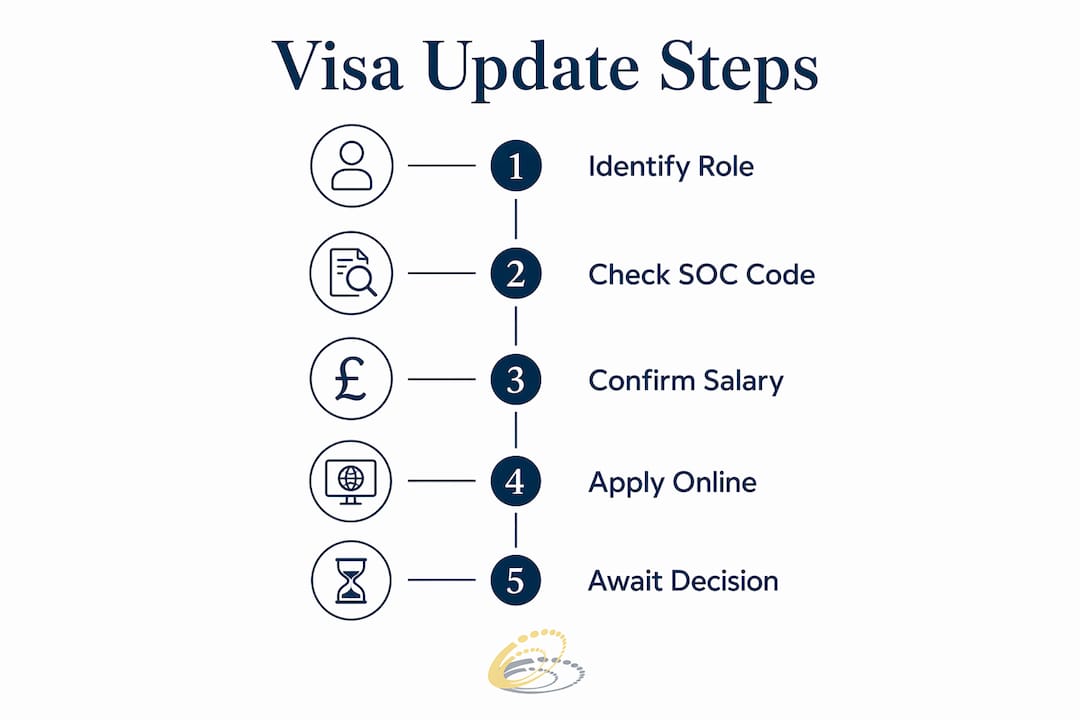
- Confirm the SOC code change. Before anything else, establish whether the promoted role genuinely falls under a different occupation code. Use the CASCOT tool, which the Office for National Statistics maintains, to map the new duties to the correct code.
- Request a new Certificate of Sponsorship. Your employer must issue a fresh CoS reflecting the updated role, SOC code, and salary. The old CoS cannot simply be amended.
- Check salary compliance. The salary offered for the promoted role must meet or exceed the going rate for the new SOC code. Previous transitional protections do not carry over automatically to a new code.
- Prepare your supporting documents. Gather your current passport, biometric residence permit, the new CoS reference number, payslips or a salary letter confirming the new rate, and a letter from your employer explaining the reason for the change.
- Submit the visa update application. You can apply up to 3 months before the start date of your new role. Apply online through the UK Visas and Immigration portal.
- Continue in your current role while you wait. You may keep working in your existing position throughout the processing period, provided your current visa has not expired. Do not start the promoted role until you receive written confirmation of your new permission.
- Receive confirmation and begin the new role. Only once the Home Office confirms your updated permission should you transition into the promoted position.
A solicitor experienced in Skilled Worker visa applications can review your CoS, confirm SOC code alignment, and prepare your application to minimise the risk of a refusal or delay.
What documents and eligibility criteria apply?
Your application will not succeed without the right documentation, and the Home Office is specific about what it requires. The eligibility criteria apply to the new role, not the old one.
The promoted role must:
- Fall within an eligible occupation code under the Skilled Worker route.
- Carry a salary that meets or exceeds the going rate for that SOC code.
- Be offered by a licensed sponsor with an active sponsor licence.
Documents you will need to submit:
- New Certificate of Sponsorship with the correct SOC code and salary details.
- Current valid passport (or travel document).
- Biometric Residence Permit issued under your existing visa.
- Salary evidence, such as a formal offer letter or recent payslips confirming the new rate.
- Employer letter explaining the nature of the job change, why the SOC code has changed, and how the new duties differ from the previous role.
- Evidence of job duties, such as a job description or organisational chart, to demonstrate alignment with the new SOC code.
One detail that catches people out: the salary threshold applies to the new code’s going rate, not the general minimum. A role under SOC 2135 (IT business analysts) carries a different going rate from SOC 3131 (IT operations technicians). Submitting a salary that meets the general threshold but falls short of the code-specific going rate is a common reason for refusal.
When should you apply, and what happens if you do not?
Timing your application correctly is as important as the application itself. The rules on this are clear, and the consequences of getting it wrong affect both you and your employer.
You can submit your visa update application up to 3 months before the start date of the promoted role. Applying early gives the Home Office time to process your case without disrupting your employer’s plans. Standard processing times for Skilled Worker visa applications vary, but the priority service can shorten the wait considerably.
The risks of not updating your visa are serious:
- Visa curtailment. The Home Office can curtail your leave if you are found working in a role that does not match your visa conditions.
- Illegal working status. Starting a promoted role under the wrong SOC code before receiving approval may constitute illegal working, regardless of your employer’s intentions.
- Sponsor licence action. Starting a promoted role before visa approval is a breach that can trigger a compliance review of your employer’s sponsor licence, potentially leading to downgrade, suspension, or revocation.
- Impact on future applications. A compliance breach on your record can complicate future visa applications, including settlement.
- Salary compliance failures. If the promoted salary does not meet the going rate for the new SOC code, your employer faces a separate compliance risk even if the visa update is eventually approved.
The risks of visa curtailment are not theoretical. In 2025, nearly 2,000 sponsor licences were revoked partly due to SOC code mismatches following promotions. That figure reflects how frequently this issue arises and how seriously the Home Office treats it.
Expert legal advice on managing visa compliance during promotions
The most common mistake employers and workers make is treating a promotion as a purely internal matter. Immigration compliance does not pause for organisational restructuring, and the legal obligations apply regardless of how routine the promotion feels internally.
Mapping new duties to the correct SOC code before a promotion is confirmed, not after, is the single most effective step an employer can take to avoid a compliance breach. Proactive SOC code assessment using CASCOT, combined with timely reporting through the Sponsor Management System, keeps both the worker’s visa and the employer’s licence secure.
Proactive SOC mapping before the promotion is confirmed is the most effective way to avoid a compliance breach. Once the role has started under the wrong code, the options narrow considerably.
Sponsors must update the Sponsor Management System within 10 working days of any change to a sponsored worker’s job title, duties, or salary, even when no new visa application is required. Many employers overlook this obligation, assuming that because no visa update is needed, no action is needed at all. That assumption is incorrect and can itself trigger a compliance review.
Practical steps for employers and workers:
- Build immigration compliance into your promotion process. HR teams should flag any role change for SOC code review before the offer is made.
- Use CASCOT to map duties. The tool is free and provides a reliable starting point for identifying the correct occupation code.
- Maintain a documentation trail. Keep records of job descriptions, CoS references, salary letters, and any correspondence with the Home Office. These are your first line of defence in an audit.
- Do not rely on assumptions about transitional protections. Salary protections that applied under the old SOC code do not transfer automatically to a new one.
- Seek legal advice early. A qualified immigration solicitor can review the new role, confirm the correct SOC code, and advise on whether a visa update is required before any commitment is made.
Including immigration compliance in promotion planning avoids operational disruption and keeps salary threshold adherence on track. The cost of getting advice before a promotion is a fraction of the cost of managing a compliance breach after one.
How Mnssolicitors can help you manage your visa update

Mnssolicitors handles Skilled Worker visa updates for workers and employers across the UK, with every case managed by a qualified solicitor from the first contact. There are no trainees handling your matter, no hidden fees, and no vague timelines. Fixed pricing means you know the cost before you commit, and the firm’s fast-track visa service can prepare applications in as little as 24 hours when timing is critical.
With over 170 five-star Google reviews and more than 27 years of experience in UK immigration law, Mnssolicitors brings the depth of expertise that a visa update following a promotion genuinely requires. Whether you need a full visa update application or simply a professional review of your SOC code position before accepting a promotion, the team is ready to advise you clearly and promptly.
Contact Mnssolicitors today for a consultation and get the clarity you need before your promotion takes effect.
Key takeaways
A Skilled Worker visa must be updated before starting any promoted role that carries a different SOC code from the one recorded on the original Certificate of Sponsorship.
| Point | Details |
|---|---|
| SOC code change triggers update | Any promotion moving you to a different occupation code requires a new Certificate of Sponsorship and visa application. |
| Apply up to 3 months early | You can submit your visa update application up to 3 months before the promoted role’s start date. |
| Do not start the new role early | Starting a promoted role before Home Office approval is a visa breach, regardless of your employer’s intentions. |
| Salary must meet the new code’s rate | The going rate for the new SOC code applies; previous salary protections do not transfer automatically. |
| Reporting is required even without a new visa | Changes to job title, duties, or salary must be reported via the Sponsor Management System within 10 working days. |
Leave a Reply