
Most visitors to the UK cannot extend their stay beyond six months in total. That is the central rule governing the UK visit visa extension process, and understanding it clearly is the first step to staying legally compliant. The standard Visitor visa permits a maximum cumulative stay of six months, and any extension must be applied for before your current permission expires, while you remain physically inside the UK.
There are, however, narrow exceptions. Visitors receiving private medical treatment can extend their stay up to a total of 11 months, academic visitors up to 12 months, and overseas medical graduates sitting the Professional and Linguistic Assessment Board (PLAB) test or undertaking clinical attachments may qualify for longer stays under strictly regulated conditions. Getting the application wrong, or missing the deadline, carries serious consequences including immediate overstayer status.
Key points at a glance:
- Standard Visitor visa extensions are capped at a total stay of six months for most applicants.
- Private medical treatment visitors may extend their stay up to a total of 11 months. Academic visitors can extend up to 12 months. PLAB test candidates and clinical attachment applicants may qualify for stays beyond six months if they meet the specific requirements for those categories.
- Applications must be submitted online before your current permission expires and while you are in the UK.
- Overstaying without a valid, timely application puts you at immediate legal risk.
- The application fee is £1,172 regardless of nationality, with an optional super priority service costing an additional £1,000.
Who is eligible to extend a UK visit visa?
The eligibility rules for extending a standard Visitor visa are specific, and most visitors will find they fall into the straightforward six-month category. If you currently hold permission to be in the UK for less than six months, you may apply to extend your stay, provided the total time in the UK does not exceed six months in total. There is no limit on how many separate extensions you can apply for, but each must be individually justified and have the required fees paid.
Your stated purpose during the extension must remain consistent with your original visit purpose. A visitor who entered for tourism cannot suddenly claim an extension on academic grounds without meeting the separate eligibility criteria for that category.
Visitors who may qualify to extend beyond six months fall into three specific groups:
- Private medical treatment patients: Those receiving ongoing treatment from a UK-registered medical practitioner or consultant may extend their stay up to 11 months total, where continued care is medically necessary.
- Academic visitors: Highly qualified individuals, such as those holding a PhD or higher, may extend their stay up to 12 months if visiting for research or a formal academic exchange and not filling a permanent teaching post.
- PLAB test candidates and clinical attachment applicants: Overseas medical graduates retaking the PLAB test or undertaking an unpaid clinical attachment or dental observer post after passing the PLAB may qualify for a stay beyond six months if meeting the respective requirements.
Each of these categories carries its own documentary requirements and maximum permitted stay, covered in detail further below. The common thread across all three is that UKVI caseworkers assess whether the applicant is a genuine visitor with a clear, permitted purpose and sufficient funds to cover their extended stay.
Pro Tip: If your circumstances have changed since you first entered the UK, seek legal advice before applying. Extending under the wrong category is one of the most common reasons applications are refused.
How to apply to extend your UK visit visa
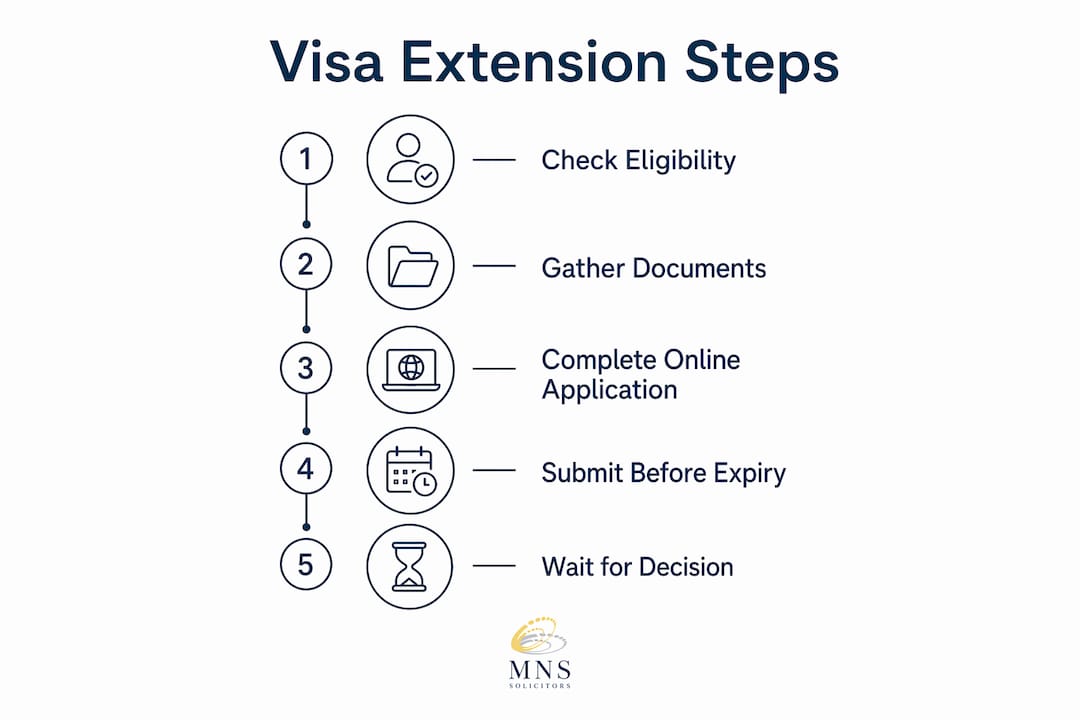
The application process is entirely online and must be completed before your current permission expires. Submitting a valid application in time is not just good practice; it is what triggers Section 3C leave, the legal protection that allows you to remain in the UK lawfully while a decision is pending. Miss the deadline, and you become an overstayer the moment your original permission ends, regardless of whether you later submit an application.

Once you have submitted your online application and paid the fee in full, you will be required to book an appointment at a UK Visa and Citizenship Application Services (UKVCAS) service point. At that appointment, you provide your biometric information, specifically your fingerprints and a photograph. There is no additional fee for the biometric submission itself.
The essential steps are:
- Complete the online extension application form on GOV.UK.
- Pay the £1,172 fee in full at the time of application.
- Upload supporting documents via the online portal or bring them to your UKVCAS appointment.
- Attend your UKVCAS appointment to submit biometric information.
- Wait for a decision without travelling outside the UK, Ireland, the Channel Islands, or the Isle of Man.
Processing times to know: Under the standard service, decisions take up to 8 weeks from the date you provide supporting documents and biometrics. The super priority service delivers a decision by the end of the next working day after your UKVCAS appointment on a weekday, or within two working days if your appointment falls at the weekend.
One point that catches many applicants off guard: travelling outside the UK while your application is pending automatically withdraws it. Your Section 3C leave protection disappears the moment you cross into another jurisdiction, and you would need to apply for a new visa from abroad. Stay put until the decision arrives.
What documents do you need for a visitor visa extension?
The documents required depend on which extension category you are applying under, but certain items are universal across all applications.
Documents required by all applicants:
- Valid passport or accepted identity document.
- Proof of your current immigration status in the UK.
- Confirmation of your online application submission.
- Biometric information provided at your UKVCAS appointment.
For visitors extending for private medical treatment, the requirements go further. You must provide a letter from a UK-registered medical practitioner or consultant confirming your condition, the necessity of continued treatment, and the expected duration. You must also demonstrate that you have paid for any treatment received to date and can meet the costs of further care. The evidence of ongoing treatment necessity must be specific and current, not a general letter of support.
Academic visitors face a different set of requirements:
- Evidence of your qualifications, such as a PhD certificate or equivalent.
- Confirmation from the UK academic institution of your research or exchange role.
- Proof that you were working in your field at an overseas institution prior to arrival.
- Where applicable, an Academic Technology Approval Scheme (ATAS) certificate if your research falls within a controlled subject area.
For PLAB candidates and clinical attachment applicants, the required documents include:
- Written confirmation from the General Medical Council (GMC) that you are retaking the PLAB test.
- A written offer of a clinical attachment or dental observer post from the relevant UK institution.
- Evidence of any previous clinical attachment undertaken in the UK.
All documents can be uploaded digitally through the online application portal or scanned at your UKVCAS appointment. Whichever route you choose, make sure every document is clear, current, and directly relevant to your stated extension purpose. Incomplete or ambiguous evidence is one of the primary reasons applications are rejected as invalid without being considered on their merits.
What are the fees for extending a UK visitor visa?
The cost of extending a standard Visitor visa is fixed and applies to every applicant regardless of nationality. As of July 2026, the fees are:
- Standard extension fee: £1,172, payable at the time of application.
- Super priority service: An additional £1,000 on top of the standard fee, for a next working day or two working day decision.
- Biometric submission: No additional charge.
There is no partial payment option. If the fee is not paid in full at the point of submission, the application is treated as invalid and will be rejected without consideration. An invalid application does not protect you under Section 3C leave, which means you could become an overstayer if your original permission has already expired by the time you resubmit.
Key financial compliance points:
- Pay the full £1,172 at the time of online submission, not at the UKVCAS appointment.
- If you choose super priority, the combined total is £2,172.
- Each separate extension application requires a full, fresh payment of £1,172.
- There are no refunds if an application is refused on eligibility grounds.
For those facing time pressure, the super priority service is worth serious consideration. An eight-week wait under the standard service can create real uncertainty, particularly if your original permission is close to expiring. The additional cost may be a practical necessity rather than a luxury, especially for medical treatment visitors whose care schedule cannot be paused.
You can find further guidance on immigration fee structures and how they compare across different application types from specialist immigration advisers.
Special cases: who can stay longer than six months?
The three categories that allow extensions beyond the standard six-month cap each operate under distinct rules, and the permitted maximum stay differs across them.
Private medical treatment visitors may extend their stay up to a total of 11 months. The extension is not automatic; it requires fresh medical evidence at each application demonstrating that treatment is ongoing and that the applicant can continue to fund their care. The treating practitioner must be registered in the UK, and the evidence must be specific to the applicant’s current condition and treatment plan.
Academic visitors can extend their stay up to a total of 12 months, provided they continue to meet the eligibility criteria throughout. They must hold a relevant postgraduate qualification, be visiting for research or a formal exchange, and must not take up a permanent teaching post at any point. Dependants of qualifying academic visitors may also apply to extend their stay for the same period, provided they meet the standard visitor requirements independently.
PLAB test candidates face a more layered set of options:
- An extension of up to six months is available to retake the PLAB test, supported by written GMC confirmation.
- If the test is passed, a further extension is available to undertake an unpaid clinical attachment or dental observer post.
- The total permitted stay across PLAB retakes and clinical attachments may extend beyond the standard duration, subject to meeting the specific requirements at each stage.
All three categories require strong, category-specific evidence. UKVI caseworkers assess each application on its individual merits, and a weak evidence bundle is treated the same as no evidence at all. If you are applying under any of these extended categories, the documentation requirements are not optional extras; they are the foundation of a valid application.
For a full breakdown of the standard visitor visa steps and how they interact with extension applications, Mnssolicitors has published detailed guidance covering the process from entry to extension.
Why expert legal advice makes a real difference
A visitor visa extension application looks straightforward on paper. In practice, the margin for error is narrow, and the consequences of getting it wrong are immediate. An invalid application does not pause the clock; it leaves you without legal status the moment your original permission expires. Many applicants discover this only after the fact.
Qualified solicitors who specialise in UK immigration law bring two things that generic guidance cannot: precise knowledge of the current Immigration Rules and the ability to assess your individual circumstances against those rules before you submit anything. That assessment can identify problems early, whether it is a mismatch between your stated purpose and your extension category, a gap in your evidence bundle, or a timing issue that requires urgent action.
The advantages of working with a specialist legal adviser include:
- Accurate assessment of which extension category applies to your situation.
- Preparation of a complete, valid application that meets all UKVI requirements.
- Guidance on gathering the right supporting documents for your specific category.
- Fast-track support where time is critical, including same-day preparation in urgent cases.
- Representation and advice if an application is refused and you need to consider next steps.
Mnssolicitors handles every enquiry through a qualified solicitor from the outset, with fixed, transparent pricing and no hidden fees. The firm’s visitor visa legal services cover the full extension process, from initial eligibility assessment through to UKVCAS appointment preparation and post-decision support. With over 170 five-star Google reviews, the firm’s track record reflects consistent, reliable outcomes for clients navigating exactly this kind of application.
For visitors whose circumstances are straightforward, the process is manageable with careful preparation. For those in the extended categories, or anyone facing a tight deadline, professional legal support is not a precaution. It is the most reliable way to protect your legal status in the UK.
Key takeaways
A UK standard Visitor visa extension is capped at six months total for most applicants, with narrow exceptions for medical, academic, and PLAB candidates requiring strong evidence and full fee payment to remain legally valid.
| Point | Details |
|---|---|
| Six-month total cap | Most visitors can only extend up to a combined total of six months in the UK. |
| Three extended categories | Medical treatment visitors can extend up to 11 months, academic visitors up to 12 months, and PLAB candidates or clinical attachment applicants may qualify for stays beyond six months depending on eligibility. |
| Application must be valid | Invalid applications do not trigger Section 3C leave, risking immediate overstayer status. |
| Fee is £1,172 | The standard extension fee applies to all nationalities; super priority costs an additional £1,000. |
| Do not travel while pending | Leaving the UK during a pending application automatically withdraws it and ends legal protection. |
Mnssolicitors can help you extend your stay with confidence
If you are currently in the UK on a Visitor visa and need to extend your stay, acting early and getting the application right the first time is the only approach that protects your legal status. Mnssolicitors offers specialist leave to remain and visa extension services, with every case handled by a qualified solicitor who understands the precise requirements of the Visitor route.
Whether your situation is straightforward or falls into one of the extended categories, Mnssolicitors provides clear, fixed-fee advice with no surprises. Fast-track preparation is available for urgent cases, with applications ready in as little as 24 hours where needed.
Contact Mnssolicitors today to discuss your extension options and get the expert support your application deserves.
Leave a Reply