
English language proficiency is a legal requirement for the UK Skilled Worker visa because UK immigration law mandates that applicants can communicate clearly in professional and everyday settings. Without a verified level of English ability, the Home Office cannot be satisfied that a migrant will integrate effectively into the workplace or wider society. From 8 january 2026, the required standard rose from B1 to B2 on the Common European Framework of Reference for Languages (CEFR) scale, a change that affects most new applicants. The requirement exists not as a bureaucratic hurdle but as a practical safeguard: a worker who cannot read contracts, follow safety instructions, or communicate with colleagues creates genuine risk for employers and colleagues alike.
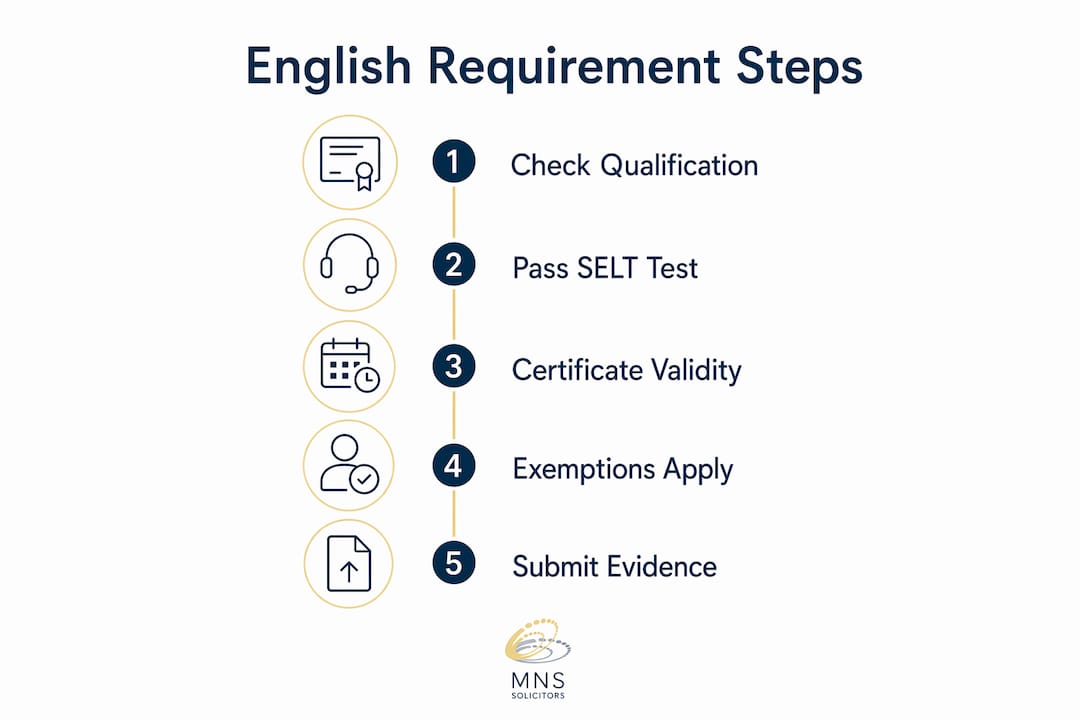
There are several ways to satisfy this requirement:
- Hold a UK school qualification (such as a GCSE or A-level) started before the age of 18
- Hold a degree awarded by a UK institution, taught in English
- Hold an overseas degree taught in English, verified by Ecctis
- Pass a Secure English Language Test (SELT) from an approved provider at B2 level
- Qualify for an exemption based on nationality, professional registration, or a previous successful visa application
Each pathway carries its own evidence requirements, and choosing the wrong one is a common reason for delays or refusals.
What English proficiency level does the Skilled Worker visa require?
The B2 CEFR standard means you can communicate fluently and spontaneously on a wide range of subjects, produce clear and detailed text on complex topics, and understand the main ideas of both concrete and abstract content. This is a meaningful step above the former B1 requirement, which broadly corresponded to GCSE-level English.
-
B2 replaces B1 for new applicants from 8 January 2026. Anyone making a fresh Skilled Worker visa application on or after that date must demonstrate B2 proficiency across reading, writing, speaking, and listening. The previous B1 standard, roughly equivalent to a GCSE pass, is no longer sufficient for new applications.
-
B1 still applies to certain extension and switching applications. If you held a Skilled Worker visa before 8 January 2026 and are applying to extend or update it, you need only demonstrate B1 level. You do not need to retake any test or submit fresh evidence of English proficiency.
-
B2 reflects the communication demands of skilled roles. Skilled Worker visa roles typically require workers to read technical documents, participate in meetings, and correspond professionally. A B2 speaker can handle all of these tasks without preparation, whereas a B1 speaker may struggle with nuanced or complex material.
-
The CEFR scale provides an internationally recognised benchmark. Developed by the Council of Europe, the CEFR runs from A1 (beginner) to C2 (mastery). B2 sits at the upper-intermediate band, well above basic conversational ability but below the near-native fluency of C1 or C2.
-
The requirement covers all four language components. Reading, writing, speaking, and listening must each meet B2. A test score that is strong in one area but weak in another will not satisfy the requirement. Approved SELT providers assess all four components in a single sitting.
-
Regulated professional bodies may set their own English standards. Doctors, nurses, dentists, midwives, and vets must pass English assessments as part of their professional registration with bodies such as the General Medical Council (GMC) or the Nursing and Midwifery Council (NMC). Where those assessments meet the visa requirement, no separate test is needed.
-
Employers sponsoring workers should factor the new standard into recruitment timelines. A candidate who meets all other Skilled Worker criteria but holds only B1 English will need time to prepare for and pass a B2 test before the visa application can proceed. Building this into the offer and onboarding timeline avoids last-minute complications.
How can you prove your English proficiency for the Skilled Worker visa?
The Home Office accepts several forms of evidence, and the right choice depends on your educational background and personal circumstances.
UK school qualifications
You can use a qualification from a UK school that you began before the age of 18. Accepted qualifications include:
- A GCSE in English language or English literature
- An A Level in English
- Scottish National Qualification level 4 or 5 in English
- Scottish Higher or Advanced Higher in English
The qualification must be from a UK institution. A GCSE obtained from an international school overseas, even one following a British curriculum, does not satisfy this route.
UK degree-level qualifications
A degree awarded by a UK institution and taught in English satisfies the requirement automatically. This applies whether you studied in the UK or abroad, provided the awarding institution is a recognised UK body. No additional verification is needed beyond the degree certificate itself.
Overseas degrees taught in English
If your degree was taught in English but awarded by a non-UK institution, you must obtain a formal Ecctis verification confirming that the qualification meets the required standard. This step catches many applicants off guard. Ecctis (formerly UK NARIC) assesses overseas qualifications against UK benchmarks, and the process takes time, so you should apply well in advance of your visa submission.
Secure English Language Tests (SELT)
If none of the qualification routes apply, you must pass a SELT from an approved provider. The test must be taken at an authorised testing centre, not online from home. Approved providers include IELTS for UKVI, LanguageCert International ESOL SELT, Pearson PTE Academic UKVI, and Trinity College London’s Integrated Skills in English (ISE). Each provider uses different scoring systems, so the minimum score you need varies by provider.
The table below shows the minimum scores required at B2 level across the main approved providers:
| Provider | Test name | Minimum B2 score |
|---|---|---|
| IELTS for UKVI | Academic or General Training | — |
| LanguageCert | International ESOL SELT | B2 Communicator pass |
| Pearson | PTE Academic UKVI | — |
| Trinity College London | ISE II | Pass in all components |
Pro Tip: Book your SELT as early as possible. Test centre availability in major cities can be limited, and results typically take 3–13 days to arrive depending on the provider. Factor in at least four weeks between booking and your planned visa submission date.
Test certificate validity
SELT certificates are valid for two years from the date of the test. If your certificate expires before you submit your visa application, you will need to retake the test. Plan your application timeline carefully, particularly if you are waiting for a Certificate of Sponsorship from your employer before you can apply.
Professionals registered with regulated bodies
Doctors, dentists, nurses, midwives, and vets who have passed an English language assessment as part of their professional registration in the UK do not need to provide separate evidence for their visa. The relevant bodies include the GMC, NMC, General Dental Council (GDC), and the Royal College of Veterinary Surgeons (RCVS). You must confirm on your application that you have met the relevant body’s English language requirements.
Who is exempt from the English language requirement?
Not every Skilled Worker visa applicant must prove their English proficiency. The Home Office recognises several categories of exemption, each with specific conditions.
-
Nationals of majority English-speaking countries do not need to provide any evidence of English ability. The list of qualifying countries includes Antigua and Barbuda, Australia, the Bahamas, Barbados, Belize, Canada, Dominica, Grenada, Guyana, Jamaica, Malta, New Zealand, St Kitts and Nevis, St Lucia, St Vincent and the Grenadines, Trinidad and Tobago, and the United States of America. Applicants from these countries simply confirm their nationality on the application form.
-
Applicants who already proved English proficiency in a previous successful UK visa application are generally exempt from proving it again. If you previously held a Skilled Worker visa, a Tier 2 (General) visa, or another route that required English evidence, and that application was successful, you do not need to resubmit evidence. This exemption applies to extension and switching applications and removes the burden of retesting for long-standing visa holders.
-
Regulated healthcare and veterinary professionals who passed an English language assessment required for registration with the GMC, NMC, GDC, or RCVS are exempt from additional testing. The assessment completed for professional registration is treated as sufficient proof. You must confirm compliance with the relevant body’s requirements on your visa application form.
-
Applicants extending or switching from a pre-January 2026 Skilled Worker visa need only demonstrate B1 level, and since they already proved this in their original application, they do not need to provide fresh evidence at all. This protects existing visa holders from being caught by the new B2 standard mid-employment.
-
Certain other visa routes carry their own English language rules under Appendix English Language of the Immigration Rules. The exemptions above apply specifically to the Skilled Worker route; applicants on other routes should check the rules for their specific visa category.
The practical effect of these exemptions is that a large proportion of Skilled Worker applicants never need to book a test. If you are unsure whether an exemption applies to your situation, taking professional advice before submitting your application can prevent an unnecessary refusal.
Why did the UK raise the English requirement to B2 in 2026?
The decision to raise the standard from B1 to B2 reflects a deliberate policy choice by the UK government, and it has generated genuine debate among immigration specialists and employers.

The government’s stated aim is to ensure that skilled migrants can handle the full range of professional and academic communication demands their roles require. At B2, a worker can read complex contracts, participate confidently in team meetings, and correspond clearly with clients and regulators. The Home Office argues that this standard better reflects the actual communication requirements of skilled employment in the UK.
Not everyone agrees the change is proportionate. Lawyer Afsana Akhtar has argued that the B2 requirement may unfairly exclude skilled workers who are fully capable of contributing to the UK economy, noting that GCSE-level B1 English is often sufficient for many technical and manual roles. The concern is particularly acute in sectors such as construction, logistics, and food production, where practical skills matter far more than the ability to write detailed prose on complex subjects.
The tension here is not trivial. Middle-skilled and technical roles often sit within the Skilled Worker route, and employers in those sectors already face recruitment challenges. Requiring a B2 test result from a candidate who will spend their working day operating machinery or following established procedures adds cost and delay without obvious safety or integration benefits. Dr Sumption’s research at the Migration Observatory highlights precisely this trade-off: better integration outcomes for some workers, at the cost of reduced recruitment flexibility for others.
At the same time, the policy has a coherent logic for roles that genuinely demand sophisticated communication. A nurse who cannot read a patient’s notes clearly, or an engineer who cannot follow written safety protocols, presents a real risk. For those roles, B2 is a reasonable floor rather than an arbitrary barrier.
Pro Tip: If you are preparing for a B2 SELT, focus your preparation on the writing and speaking components first. These are the areas where candidates most often fall short of the B2 threshold, particularly in producing detailed, structured responses on unfamiliar topics. Dedicated preparation courses from providers such as the British Council can significantly improve your score within six to eight weeks.
The 2026 update to the Skilled Worker visa requirements means that both applicants and sponsoring employers need to plan ahead. Candidates who are close to the B2 threshold should allow time for test preparation and a potential resit before their Certificate of Sponsorship is issued. Employers who understand the new standard early can build it into their recruitment process without disrupting their hiring timelines.
How Mnssolicitors can help you meet the English language requirement

Meeting the English language requirement is one part of a Skilled Worker visa application that can derail an otherwise strong case if it is not handled correctly. Choosing the wrong evidence route, submitting an expired test certificate, or failing to obtain Ecctis verification for an overseas degree are all avoidable mistakes that Mnssolicitors sees regularly.
Mnssolicitors handles every Skilled Worker visa enquiry with a qualified solicitor from the outset, not a trainee or a case handler working from a checklist. With over 170 five-star Google reviews and a fast-track service that can prepare applications in as little as 24 hours, the firm is built for applicants who cannot afford delays. Fixed, transparent pricing means you know the cost before any work begins.
If you need expert immigration advice on your Skilled Worker visa application, including guidance on the B2 English requirement and which evidence route applies to your circumstances, contact Mnssolicitors today.
Key takeaways
The UK Skilled Worker visa requires B2 English proficiency for all new applicants from 8 january 2026, with accepted evidence including UK qualifications, degrees, Ecctis-verified overseas degrees, and approved SELT results.
| Point | Details |
|---|---|
| B2 standard from january 2026 | New Skilled Worker visa applicants must demonstrate B2 CEFR proficiency across all four language components. |
| Extension applicants keep B1 | Those extending a pre-january 2026 Skilled Worker visa need only B1 and do not need to retest. |
| Four accepted evidence routes | UK school qualifications, UK degrees, Ecctis-verified overseas degrees, and approved SELT results all satisfy the requirement. |
| SELT certificates last two years | Test results expire after two years, so application timing must account for certificate validity. |
| Key exemptions apply | Nationals of majority English-speaking countries and registered healthcare professionals are exempt from providing English evidence. |
Leave a Reply