
Vaccination records are a mandatory part of the medical evidence required to support a successful UK family visa application. The Home Office reviews health documentation to confirm that applicants meet public health standards, and incomplete medical evidence is a recognised cause of application refusals and delays. Understanding why vaccination records are needed for a family visa protects your application from avoidable setbacks before you even reach the decision stage.
Why vaccination records are needed for a UK family visa
Vaccination records serve as formal proof that an applicant complies with the immunisation standards required by UK immigration authorities. The vaccination requirements function primarily as a public health measure, designed to match the UK’s immunisation norms and protect communities from vaccine-preventable diseases. Without this proof, the Home Office cannot confirm that an applicant poses no public health risk, which directly affects admissibility.
Family visa applicants undergo a medical examination conducted by an authorised clinician or panel physician. During this examination, vaccination records are reviewed alongside other health evidence. The records confirm immunity across age groups, from infants through to adults, and support the overall admissibility decision made by immigration authorities.

The vaccination requirements for a family visa are not arbitrary. They reflect established public health policy and align with internationally recognised immunisation schedules. Families who treat vaccination documentation as a core part of their application, rather than an afterthought, consistently experience smoother processing.
What vaccines are typically required
The ACIP vaccination schedule requires immunisation against diseases including MMR (measles, mumps, and rubella), polio, Tdap (tetanus, diphtheria, and pertussis), varicella, and hepatitis B, organised by age group. Applicants are only required to complete the vaccines appropriate to their current age group, not every vaccine on the schedule. This is a common misconception that causes unnecessary anxiety for families preparing their documents.
The key vaccines to confirm for family visa vaccination documentation include:
- MMR (measles, mumps, and rubella): required across most age groups
- Polio: required for children and adults who lack documented immunity
- Tdap: required for adolescents and adults, with booster records needed
- Varicella: required unless prior infection is documented by a clinician
- Hepatitis B: required for children and certain adult age groups
Pro Tip: Confirm your age-appropriate vaccine requirements with an authorised panel physician before your medical appointment. Arriving with a complete, certified record avoids on-the-spot vaccinations and the fees that accompany them.
What happens if your vaccination records are missing or incomplete?
Missing or uncertified vaccination records create concrete, costly problems for family visa applicants. Applicants without proper documentation may face additional vaccinations at extra cost, repeated medical appointments, and significant delays to their visa processing timeline. The Home Office may also issue a formal Request for Evidence, which pauses the application entirely until the gap is resolved.
Immigration practitioners refer to a specific risk known as the “Civil Surgeon Trap.” This arises when applicants arrive at their medical examination without certified records from their home country, forcing them to repeat vaccinations or undergo additional examinations in the destination country. The result is a delay that can extend processing by weeks or months, along with additional medical fees.
The most common pitfalls families encounter with family visa vaccination documentation are:
- Uncertified local health records: Records issued by a GP or local clinic without official certification are routinely rejected. Certified records from authorised physicians are the only acceptable standard.
- Missing translations: Foreign-language vaccination records require certified and notarised translations. Simple English translations without official stamps and endorsements are a frequent cause of rejection.
- Incomplete vaccination history: Gaps in the record, such as missing booster doses, raise questions about immunity status and trigger further investigation.
- Records that do not match the applicant’s identity: Name discrepancies between vaccination records and passport documents cause immediate problems at the medical examination stage.
Pro Tip: Request a certified copy of your vaccination history directly from your national health authority or GP surgery at least six weeks before your medical appointment. This gives you time to address any gaps without delaying your application.
How to prepare your vaccination records for a UK family visa
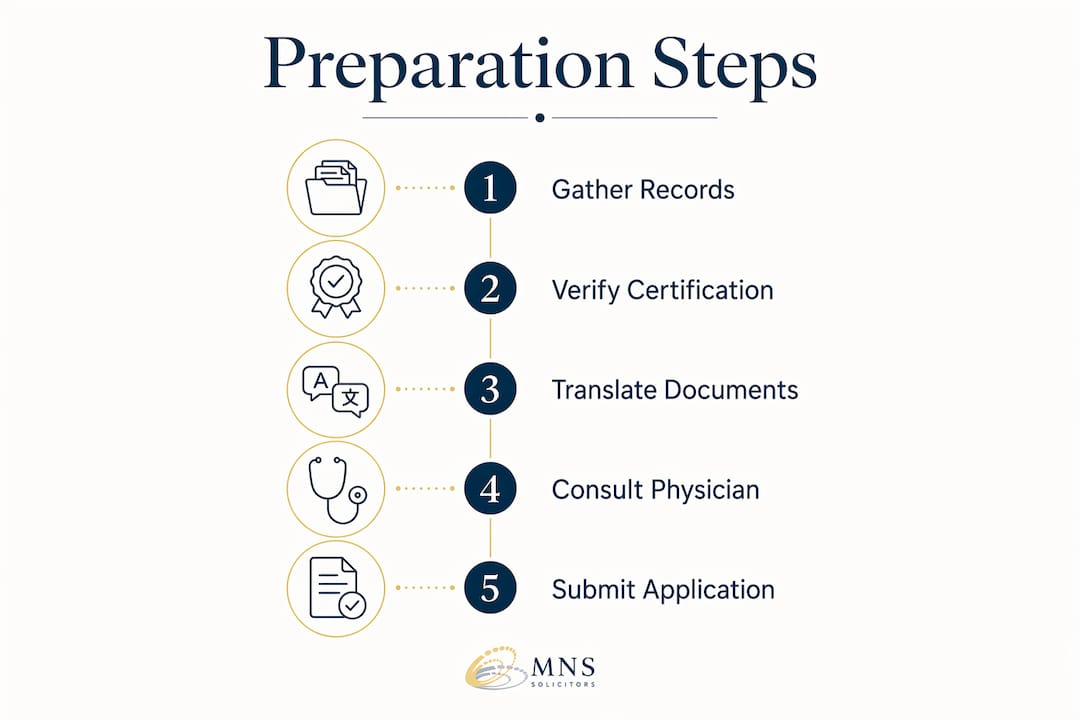
Thorough preparation of family visa vaccination documentation begins well before the medical examination date. The process of reconciling vaccination records before the visa medical minimises delays and produces a smoother immigration process overall. Families who prepare early avoid the most common documentation failures.
Follow these steps to prepare your records correctly:
- Obtain originals from your healthcare provider: Request your original vaccination card or an official immunisation report from your GP, national health authority, or the clinic that administered the vaccines. Photocopies are not sufficient.
- Arrange certified translations: If your records are in a language other than English, commission a certified and notarised translation. The translation must replicate all official stamps, endorsements, and signatures present on the original document.
- Consult an authorised panel physician early: Book a pre-visa medical consultation to confirm your vaccination status against the required schedule. The physician can identify gaps and advise on how to address them before the formal examination.
- Keep digital and physical copies: Store scanned copies of all vaccination documents securely. Bring both originals and copies to every medical appointment and keep them accessible throughout the application process.
The table below summarises the key document requirements for vaccination records submitted as part of a UK family visa application:
| Document type | Requirement |
|---|---|
| Original vaccination card | Must be issued by a recognised healthcare provider or national health authority |
| Certified translation | Required for all non-English records; must include official stamps and endorsements |
| Notarisation | Required where the issuing country’s records lack official certification |
| Panel physician confirmation | Written confirmation of vaccination status from an authorised clinician |
| Digital copies | Scanned backups of all originals, stored securely and accessible on request |
The importance of vaccination records extends beyond the medical examination itself. The Home Office reviews all submitted medical evidence when assessing an application, and discrepancies between vaccination records and other submitted documents can trigger further scrutiny.
Do children and dependants need vaccination records too?
Children and dependants applying under family visa routes must also comply with immunisation standards. Children applying for dependent passes in comparable immigration systems must present formal vaccination verification issued by health authorities, confirming compliance with age-appropriate immunisation requirements. The same principle applies to UK family visa dependants.
Parents often assume that young children require fewer documents than adult applicants. This assumption leads to gaps in the application. Key considerations for children and dependants include:
- Age-appropriate vaccine records: Children require proof of the vaccines relevant to their age group, which changes as they grow. A record that was complete at age two may be incomplete by age five.
- Verification of Vaccination documents: Some jurisdictions issue a formal Verification of Vaccination document for children. Where this exists, it should be included in the application.
- Country-specific certificate formats: Vaccination certificate formats vary significantly between countries. Records from some countries may not include all the fields that UK authorities expect to see, so a panel physician review is particularly valuable for children born outside the UK.
- Exemptions and medical exceptions: Where a child cannot receive a specific vaccine for medical reasons, a written exemption from a qualified clinician must accompany the application. The exemption must explain the medical basis clearly.
The family visa checklist for dependants should treat vaccination records with the same priority as identity documents. Incomplete records for a child can delay the entire family application, not just the child’s individual entry clearance.
Key takeaways
Vaccination records are a non-negotiable part of UK family visa applications, and incomplete or uncertified documentation is one of the most preventable causes of refusal.
| Point | Details |
|---|---|
| Records prove public health compliance | Vaccination documentation confirms immunity and supports admissibility decisions by the Home Office. |
| Certification is mandatory | Only original, certified records from authorised clinicians or health authorities are accepted. |
| Translations must be notarised | Foreign-language records require certified, notarised translations that replicate all official stamps. |
| Children need age-appropriate proof | Dependants must provide vaccination records relevant to their current age group, not a general history. |
| Early preparation prevents delays | Reconciling records before the medical examination avoids the Civil Surgeon Trap and extra costs. |
What I have learned from watching families get this wrong
The single most consistent error I see families make is treating vaccination records as a formality to sort out at the last minute. By the time they realise their records are uncertified, or that a translation is missing an official stamp, the medical appointment is already booked and the timeline is under pressure.
The families who sail through the medical examination stage are the ones who requested their vaccination history from their GP or national health authority two months in advance. They had time to identify gaps, arrange certified translations, and consult a panel physician without rushing. That preparation is not complicated. It simply requires starting early.
There is also a widespread belief that children’s vaccination records are less scrutinised than adults’. That belief is wrong. A child’s incomplete record can hold up an entire family application. I have seen cases where one missing booster dose for a toddler triggered a Request for Evidence that delayed a family’s reunion by three months.
My practical advice is this: treat your vaccination records as you would treat your passport. Keep originals safe, maintain certified copies, and never assume that what was acceptable in your home country will automatically satisfy UK requirements. If you are uncertain whether your records meet the standard, consult a qualified immigration solicitor before the medical appointment, not after. For cases involving visa documentation appeals, the cost of early advice is always lower than the cost of correcting a refusal.
— michelle
How Mnssolicitors can support your family visa application
Preparing vaccination records correctly is one part of a broader family visa application that demands precision at every stage. Mnssolicitors specialises in UK family visa applications and works with families to ensure that every document, including vaccination evidence, meets Home Office standards before submission.

Mnssolicitors handles every enquiry through a qualified solicitor from the first contact, with fixed, transparent pricing and no hidden fees. For families facing tight timelines, the firm’s fast-track service can prepare a visa application in as little as 24 hours. Whether you need guidance on spouse visa documentation or support with a complex dependant application, Mnssolicitors provides clear, expert advice backed by over 170 five-star Google reviews. Contact the team today to confirm your vaccination documentation meets the required standard before your medical appointment.
FAQ
Why are vaccination records needed for a family visa?
Vaccination records confirm that applicants comply with public health immunisation standards, which the Home Office requires as part of the medical evidence for family visa applications. Discrepancies in medical documentation are a recognised cause of application refusals.
Which vaccines are required for a UK family visa medical?
The vaccines required depend on the applicant’s age group and typically include MMR, polio, Tdap, varicella, and hepatitis B, aligned with ACIP or equivalent immunisation schedules. Applicants only need the vaccines appropriate to their current age, not every available vaccine.
What happens if my vaccination records are not certified?
Uncertified records are not accepted at the medical examination stage. Missing certified documentation can result in additional vaccinations, extra medical fees, and significant delays to your visa processing timeline.
Do children need separate vaccination records for a family visa?
Yes. Children and dependants must provide age-appropriate vaccination records as part of the family visa application. Formal vaccination verification for children is required, and incomplete records for a dependant can delay the entire family application.
Are translated vaccination records accepted for a UK family visa?
Translated records are accepted only when the translation is certified and notarised. Simple translations without official stamps are a common cause of rejection, so the translation must replicate all endorsements present on the original document.
Leave a Reply