
The parent visa UK application steps follow the official UK Family Visa route, governed by UK Visas and Immigration (UKVI), and require parents to prove eligibility, submit the correct forms, and provide strong documentary evidence. Getting this right from the start is the difference between approval and a costly refusal. The process is demanding, but it is entirely manageable when you understand what UKVI expects at each stage. This guide covers eligibility, documentation, the step-by-step process, and the most common mistakes parents make, so you can apply with confidence.
What are the eligibility requirements for a UK parent visa?
The UK parent visa, formally part of the Family Visa category under Appendix FM of the Immigration Rules, is available to parents of a child under 18 who is living in the UK. The child must be a British citizen, a settled person, or hold an appropriate immigration status recognised by UKVI. Meeting these basic criteria is only the starting point.

Relationship and responsibility requirements
You must demonstrate one of two things to qualify. Either you have sole responsibility for the child’s upbringing, or there are serious and compelling family or other considerations that make it desirable for you to be granted entry. The sole responsibility test carries a high burden of proof. UKVI expects clear evidence that you have exercised primary control over the child’s day-to-day life, education, and welfare, and that the child cannot remain with the other parent overseas.
Financial and accommodation requirements
You must show you can maintain and accommodate the child without relying on public funds. UKVI does not set a fixed income threshold for this route, but financial documentation must be transparent, consistent, and easy for a caseworker to interpret. Vague or incomplete financial evidence is one of the most common reasons for refusal.
- The child must be under 18 at the date of application.
- The child must be a British citizen, settled, or hold a recognised immigration status.
- You must prove sole responsibility or compelling family considerations.
- You must demonstrate the ability to maintain and accommodate the child.
- You must not have a criminal record that would bar entry under the Immigration Rules.
Pro Tip: If you are applying on the basis of compelling family considerations rather than sole responsibility, gather written evidence from schools, medical professionals, or social workers who can confirm the child’s need for your presence in the UK.
What documents do you need for a UK parent visa application?
Strong documentation is the foundation of a successful application. UKVI caseworkers assess your evidence against the eligibility criteria, so every document must be relevant, current, and clearly organised.
Core documents required
- Proof of parental relationship: the child’s birth certificate naming you as a parent, or a court order confirming parental responsibility.
- The child’s identity documents: passport, British citizenship certificate, or biometric residence permit.
- Evidence of the child’s immigration status in the UK.
- Proof of sole responsibility or compelling family considerations: school records, medical letters, correspondence showing your involvement in the child’s life.
- Financial documents: bank statements, payslips, pension statements, or evidence of savings covering at least the past six months.
- Accommodation evidence: tenancy agreement or mortgage statement for the UK address where the child lives.
Sponsor documents (if applicable)
If a sponsor in the UK is supporting your application, you will need their passport or travel document, proof of their immigration status, and evidence of their UK address. A well-structured invitation letter from the sponsor must specify the purpose of the visit, the accommodation arrangements, the sponsor’s immigration status, and the nature of your relationship. A generic letter weakens the application and increases the risk of refusal.
Pro Tip: Organise your documents in the same order as the application form sections. Caseworkers process large volumes of applications, and a clearly structured bundle makes it easier for them to verify your evidence quickly.
| Document type | Purpose |
|---|---|
| Birth certificate | Proves parental relationship with the child |
| Child’s passport or BRP | Confirms identity and immigration status |
| Bank statements (6 months) | Demonstrates financial capacity to maintain child |
| Tenancy or mortgage agreement | Confirms suitable accommodation in the UK |
| Sponsor invitation letter | Supports purpose of application and accommodation |
| School or medical letters | Evidences sole responsibility or compelling need |
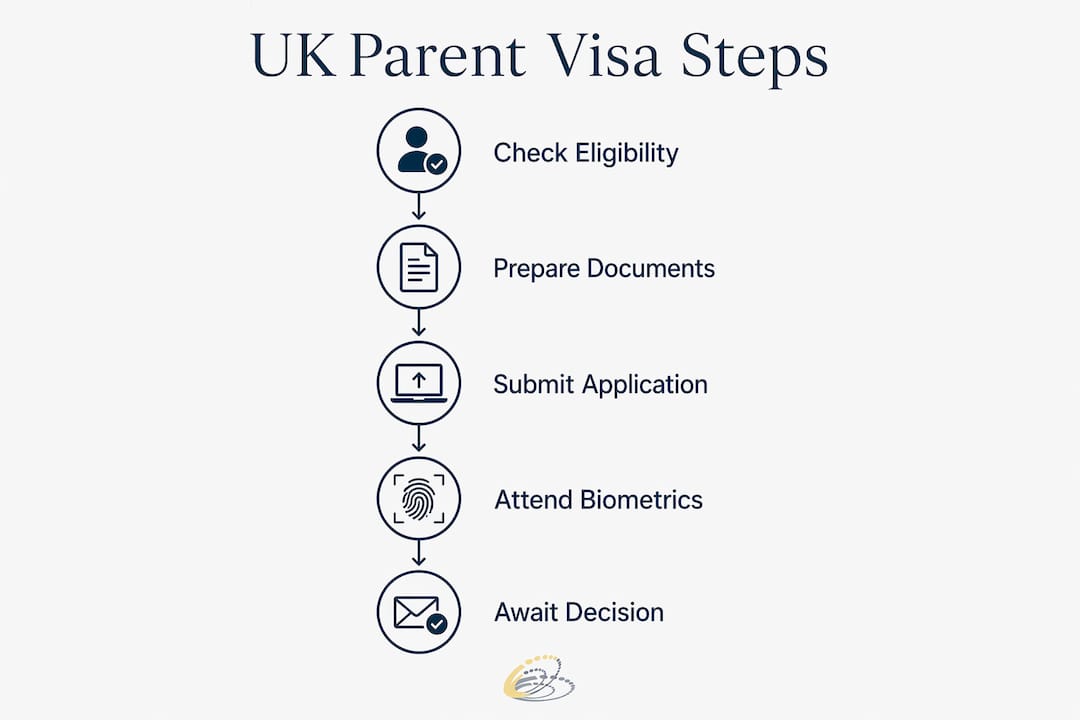
How to complete the parent visa application: step-by-step process
The UK parent visa process follows a structured sequence. Skipping or rushing any step creates errors that UKVI will use as grounds for refusal.
-
Identify the correct visa category. Confirm you are applying under Appendix FM of the Immigration Rules, specifically the parent route. Do not confuse this with the Standard Visitor Visa, which carries different requirements and does not grant the right to settle.
-
Complete the application form accurately. The correct form is VAF4A Appendix 5, submitted online through the UKVI portal. Applications from outside the UK are made via the Gov.uk online system. Applications from inside the UK follow the leave to remain process. Every field must be completed fully and accurately.
-
Pay the visa fee and Immigration Health Surcharge. Fees vary depending on whether you are applying from inside or outside the UK and the duration of leave sought. Pay both the application fee and the Immigration Health Surcharge at the time of submission.
-
Upload supporting evidence. Attach all documents in the formats accepted by UKVI. Scan documents clearly and label each file so caseworkers can identify them without confusion.
-
Book and attend your biometric appointment. After submitting the application, you will receive instructions to attend a visa application centre to provide fingerprints and a photograph. Bring your original documents to this appointment.
-
Attend an interview if requested. UKVI may request an interview to verify the details of your application. Answer questions consistently with your written evidence.
-
Await the decision and act on the outcome. Processing times vary. If approved, you will receive a vignette visa or a biometric residence permit. If refused, you will receive a refusal letter explaining the reasons.
Incomplete or unsigned forms result in delays or outright refusals. Cross-check every section of the application before submission. Inconsistent dates, missing address history, or omitted family members are among the most common errors that lead to a negative decision. Review your application as if you were the caseworker reading it for the first time.
Common application challenges and how to avoid mistakes
The parent visa application fails most often not because of ineligibility, but because of avoidable errors in the application itself. Understanding where applicants go wrong gives you a clear advantage.
- Incomplete or unsigned forms. Inconsistent dates, incomplete address history, or omitted family members are frequent causes of refusal. Check every section twice before submitting.
- Insufficient evidence of sole responsibility. Legal professionals consistently highlight the demanding nature of this test. You must document that you have exercised primary control over the child’s upbringing and explain clearly why the child cannot remain with the other parent.
- Weak financial documentation. Bank statements with unexplained large deposits or withdrawals raise questions. Provide a brief written explanation for any unusual transactions.
- Generic invitation letters. A letter that does not specify accommodation details, the sponsor’s immigration status, or the nature of the relationship will weaken your application significantly.
- Confusing the parent visa with a visitor visa. Parents do not have automatic visitor rights and must satisfy the genuine visitor test every time they enter the UK on a visitor visa. This is a common misconception that leads to refusals and entry denial.
Pro Tip: Retired parents applying for any UK visa face particular scrutiny. UKVI looks for strong home country ties such as property ownership, pension income, or family dependants to confirm you intend to return. Gather this evidence proactively, even if it is not explicitly requested on the form.
For parents considering a short visit rather than settlement, the genuine visitor test requires proof of strong ties to your home country. Retired applicants especially need evidence like property ownership or pension income to pass this test.
What are the alternatives if the UK parent visa is refused?
A refusal is not the end of the process. UKVI provides several routes for applicants to challenge a decision or reapply with stronger evidence.
- Reapplication with strengthened evidence. Address every reason cited in the refusal letter directly. A reapplication that ignores the stated grounds for refusal will almost certainly fail again.
- Administrative review. If you believe UKVI made a caseworking error, you can request an administrative review. This is not an appeal on the merits of the decision; it challenges whether the rules were applied correctly.
- Formal appeal. In some cases, you have the right to appeal to the First-tier Tribunal (Immigration and Asylum Chamber). Legal assistance significantly improves the chance of success in appeals or reapplications.
- Alternative visa routes. If settlement is not immediately achievable, a Standard Visitor Visa may allow temporary visits while you strengthen your case for the parent route. Use this option carefully. Overstaying or failing the genuine visitor test creates a negative immigration history that complicates future applications.
- Seek professional legal advice. An immigration solicitor can identify weaknesses in your original application, advise on the strongest grounds for challenge, and prepare a well-evidenced reapplication. The family reunion visa checklist is a useful starting point for reviewing what evidence you may have missed.
Key takeaways
The parent visa UK application succeeds when you meet the eligibility criteria under Appendix FM, submit the correct form with complete and consistent evidence, and address the sole responsibility or compelling family considerations test with strong documentary proof.
| Point | Details |
|---|---|
| Eligibility under Appendix FM | The child must be under 18, British or settled, and you must prove sole responsibility or compelling need. |
| Document quality matters | Every document must be current, clearly labelled, and directly relevant to the eligibility criteria. |
| Form accuracy is critical | Incomplete forms, inconsistent dates, or missing family members are leading causes of refusal. |
| Invitation letters must be specific | Generic letters weaken applications; include accommodation, sponsor status, and relationship details. |
| Refusal is not final | Administrative review, formal appeal, or a strengthened reapplication can overturn a negative decision. |
What I have learned from watching parent visa applications succeed and fail
After years of working in UK immigration law, the pattern I see most often is this: parents who prepare thoroughly succeed, and those who underestimate the evidence burden do not. The sole responsibility test is where most applications fall apart. Applicants assume that being the primary carer is self-evident. UKVI does not share that assumption. You need letters from schools, medical records, financial records showing you fund the child’s life, and a clear written explanation of why the other parent is not involved. The more specific and corroborated your evidence, the stronger your case.
Retired parents face a separate challenge that many overlook entirely. Without employment to anchor them to their home country, UKVI scrutinises their intention to return very carefully. I have seen applications refused simply because the applicant could not demonstrate meaningful ties at home. Property ownership, pension documentation, and evidence of family members remaining abroad all carry real weight.
The other mistake I see repeatedly is treating the application as a form-filling exercise rather than a legal submission. Every section of the application tells a story. Inconsistencies between your form and your documents give caseworkers a reason to doubt you. Prepare your evidence first, then complete the form to match it, not the other way around.
— michelle
How Mnssolicitors can support your UK parent visa application
Applying for a UK parent visa is one of the most document-intensive processes in the Family Visa category. Getting the evidence bundle right, completing the form accurately, and addressing the sole responsibility test with authority all require legal knowledge that goes beyond general guidance.

Mnssolicitors handles UK parent visa applications from start to finish, with every case managed by a qualified solicitor from the first contact. The firm offers fixed, transparent pricing with no hidden fees, and a fast-track service that can prepare applications in as little as 24 hours for urgent cases. With over 170 five-star Google reviews, Mnssolicitors has a proven record of guiding parents through the UK visa process successfully. For specialist support with your application, visit the visitor visa service page or contact the team directly for a consultation.
FAQ
What is the parent route UK visa?
The parent route UK visa is a category under Appendix FM of the Immigration Rules that allows a parent to join or remain with their child in the UK. The child must be under 18, British, settled, or hold a recognised immigration status.
How do I prove sole responsibility for a child visa application?
You must provide documentary evidence showing you have exercised primary control over the child’s upbringing, including school records, medical correspondence, and financial records. UKVI also requires an explanation of why the child cannot remain with the other parent.
What documents are needed for a UK parent visa application?
Core documents include the child’s birth certificate, passport, and proof of immigration status, alongside your financial statements, accommodation evidence, and proof of sole responsibility or compelling family considerations.
Can a retired parent apply for a UK visa to visit their child?
Yes, but retired parents must satisfy the genuine visitor test by demonstrating strong home country ties such as property ownership, pension income, or family dependants remaining abroad. Without this evidence, the application is at high risk of refusal.
What happens if a UK parent visa application is refused?
You can request an administrative review, lodge a formal appeal with the First-tier Tribunal, or reapply with strengthened evidence. Legal advice from a qualified immigration solicitor significantly improves the outcome of appeals and reapplications.
Leave a Reply