
Switching a UK visa is defined as applying to change your immigration category whilst remaining in the United Kingdom, and why switching visa requires care becomes clear the moment you understand the legal framework that governs it. The UK Home Office administers these rules under the Immigration Act 1971 and the Immigration Rules, and both are unforgiving of errors. A mistimed application, a prohibited route, or missing documentation can result in refusal, unlawful presence, or a permanent mark on your immigration record. Getting it right the first time is not optional. It is the only acceptable outcome.
Why switching visa requires care: routes, rules, and real risks
Switching is not a universal right. Visa switching is restricted to specific immigration routes to prevent abuse of the system. The UK Home Office permits certain in-country switches, but expressly prohibits others, and the distinction matters enormously.

Permitted switching routes
Several common switches are allowed under the Immigration Rules. These include:
- Student to Skilled Worker Visa: One of the most frequently used routes. A student who has completed their studies and secured a job offer from a licensed sponsor can switch without leaving the UK.
- Skilled Worker to Spouse or Family Visa: Permitted where the applicant meets the financial and relationship requirements.
- Graduate Visa to Skilled Worker Visa: Graduates on the Graduate route can switch to a Skilled Worker Visa once they have a qualifying job offer.
- Tier 1 or Tier 2 legacy routes to equivalent modern routes: Permitted where the applicant meets current eligibility criteria.
These routes share a common feature. They all require the applicant to hold valid leave at the point of application and to meet the full eligibility criteria for the new category.
Prohibited switching routes
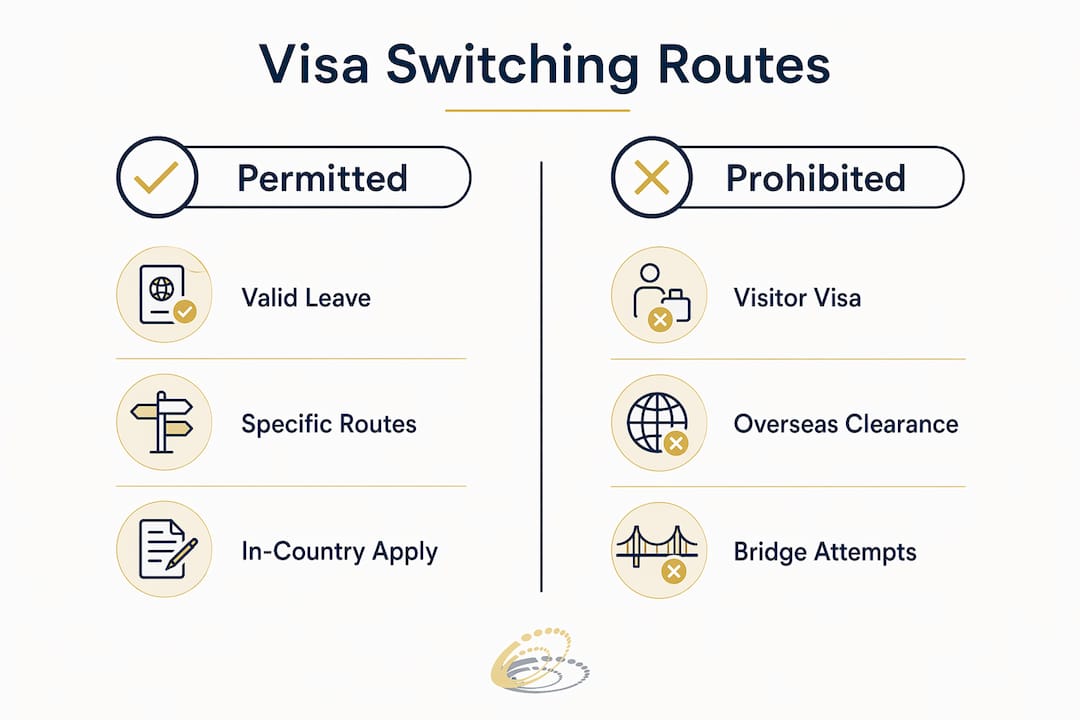
The Visitor visa is the most significant prohibition. The Visitor route expressly prohibits in-country switching in most cases. Attempting to switch from a Visitor visa to a work or study visa from within the UK results in automatic refusal. The reason is structural. The genuine visitor test requires that you intend to leave the UK at the end of your visit. Switching mid-visit directly contradicts that intention.
Attempting to use a Visitor visa as a bridge to another status is a high-risk approach that frequently results in long-term inadmissibility. A refusal on these grounds can also trigger a paragraph 320 credibility finding, which damages every future application you make. You can read more about the specific risks in our visitor visa guide.
Some visa categories can only be entered via overseas entry clearance. This means you must leave the UK, apply from your home country, and re-enter on the new visa. Attempting to switch on these routes from within the UK results in refusal and immigration penalties.
Pro Tip: Before you do anything else, check whether your current visa category is on the list of permitted switching routes. If it is not, you must apply from overseas. Applying in-country on a prohibited route wastes your application fee and damages your record.
What timing considerations and deadlines impact visa switching success?
Timing is the single most controllable factor in a visa switch, and it is also the most commonly mismanaged. The legal protection that keeps you lawfully present during a switch depends entirely on when you submit your application.
Section 3C leave explained
Section 3C of the Immigration Act 1971 preserves your lawful status during application processing, but only if you submit your application before your current leave expires. This is called Section 3C leave. It means that if your application is still being decided after your visa expiry date, you remain lawfully present. The moment your leave expires before you apply, that protection disappears entirely.
The practical steps to protect your timing are:
- Check your visa expiry date immediately. Do not rely on memory. Check the physical document or your online immigration status.
- Identify your target route and eligibility requirements. Some routes require a sponsor letter, a certificate of sponsorship, or an English language test result. These take time to obtain.
- Begin gathering documentation at least three months before expiry. Delayed filing often stems from underestimating how long documentation gathering and sponsor delays take.
- Submit your application before your current leave expires. Not on the day it expires. Before it expires.
- Keep records of your submission confirmation. This is your evidence of Section 3C leave if any question arises.
Applications filed after status expiry lose protection, resulting in unlawful presence and potential removal proceedings. The consequences are not administrative inconveniences. They are legal barriers that can follow you for years.
The most common timing mistake is underestimating how long it takes to secure a certificate of sponsorship from an employer. Employers have their own internal processes, and delays are frequent. Build that time into your planning from the outset.
What are the practical risks and consequences of careless visa switching?
Careless visa switching produces consequences that range from inconvenient to career-ending in terms of UK immigration prospects. Understanding the worst-case outcomes is the clearest reason to take the process seriously.
Refusal and prohibited routes
Attempting to switch on a route not permitted by the Immigration Rules results in refusal. The refusal itself is recorded on your immigration history. Future applications require you to disclose previous refusals, and a pattern of refusals reduces your credibility with decision-makers.
Unlawful presence and inadmissibility bars
Denied switching applications on expired leave lead to unlawful presence and can trigger formal removal notices. In comparable immigration systems, extended unlawful presence triggers 3-year or 10-year inadmissibility bars. The UK equivalent is the general grounds for refusal under paragraph 320 of the Immigration Rules, which gives decision-makers broad discretion to refuse future applications based on past non-compliance.
“Visa switching errors cause long-term immigration record damage, complicating future renewals and applications. Immigration violations are permanent and affect credibility and adjustment of status options.” Source
Paragraph 320 credibility findings
A paragraph 320 finding is one of the most damaging outcomes of a careless switch. It signals to the Home Office that you have previously breached immigration conditions or made a deceptive application. This finding does not expire. It follows every subsequent application, whether for a work visa, a spouse visa, or indefinite leave to remain.
The risks of careless switching can be summarised as follows:
- Visa refusal on grounds of prohibited route or late application
- Accrual of unlawful presence and potential removal proceedings
- Paragraph 320 credibility findings affecting all future applications
- Loss of eligibility for certain routes that require a clean immigration history
- Damage to employer relationships where a sponsored visa is involved
How to prepare a careful visa switching application
Preparation is the difference between a successful switch and a costly refusal. The steps below reflect best practice for any in-country switching application.
Verify eligibility before anything else
Confirm that your current visa category permits in-country switching to your target route. Switching routes are graded by complexity, and even permitted switches may require expert legal guidance. Simple switches such as Student to Skilled Worker are considered Level 1 OISC work. More complicated cases, such as those involving dependants, previous refusals, or complex employment arrangements, require Level 2 advice from a regulated solicitor.
Gather documentation systematically
The following documents are typically required, depending on your target route:
- Valid passport with sufficient remaining validity
- Biometric Residence Permit for your current visa
- Certificate of sponsorship from a licensed employer (for work routes)
- Confirmation of Acceptance for Studies from a licensed institution (for student routes)
- English language test certificate where required
- Financial evidence meeting the relevant maintenance threshold
- Relationship evidence where switching to a family route
Early legal advice and thorough preparation increase switching application success rates and minimise errors. Regulated advisers help determine whether switching is permitted, confirm the timing, and identify the precise evidence requirements for your specific case.
Pro Tip: Do not submit your application until your documentation is complete. An incomplete application is not better than a late one. Both carry serious risks. A qualified solicitor can review your file before submission to catch gaps you may have missed.
Consider leave to remain options if your circumstances are complex or if you are unsure whether a direct switch is the right route for your situation.
Key takeaways
Careful visa switching in the UK requires submitting a valid application before current leave expires, on a permitted route, with complete documentation, and with professional legal support for any case involving complexity.
| Point | Details |
|---|---|
| Timing is legally critical | Section 3C leave only protects you if you apply before your current visa expires. |
| Not all routes permit switching | Visitor visa holders must apply from overseas; in-country switching on this route leads to automatic refusal. |
| Refusals carry lasting consequences | A paragraph 320 finding damages every future UK immigration application you make. |
| Documentation delays cause failures | Begin gathering sponsor letters and certificates at least three months before your visa expires. |
| Legal advice reduces risk | Regulated solicitors identify prohibited routes, timing errors, and evidence gaps before you submit. |
The uncomfortable truth about visa switching that most people learn too late
Having worked in UK immigration law for many years, the pattern I see most often is not ignorance. It is overconfidence. People research their target visa, confirm they meet the salary threshold or the English language requirement, and assume the rest will follow. What they miss is the procedural layer beneath the eligibility criteria.
The most damaging misconception I encounter is the belief that switching is a straightforward administrative step. It is not. The Immigration Rules contain express prohibitions, timing traps, and credibility tests that operate independently of whether you qualify for the new visa on its merits. You can be fully eligible for a Skilled Worker Visa and still have your application refused because you applied one day after your Student Visa expired.
The second misconception is that a refusal can be quietly corrected by reapplying. A refusal is a permanent record. A paragraph 320 finding is a permanent record. The Home Office does not forget, and future decision-makers will see everything.
My honest recommendation is this: if your switch involves any complexity at all, whether that means previous refusals, dependants, gaps in employment, or an unusual route, consult a regulated immigration solicitor before you submit anything. The cost of professional advice is a fraction of the cost of a refusal, an appeal, or a removal notice. The emergency visa guidance from Mnssolicitors is a useful starting point if you are already close to your expiry date and need to act quickly.
Precision in this process is not bureaucratic pedantry. It is the only thing standing between you and a consequence that cannot be undone.
— michelle
How Mnssolicitors supports careful visa switching
Visa switching applications carry real legal risk, and the stakes are too high for guesswork or generic online advice.

Mnssolicitors specialises in UK visa and immigration law, and every enquiry is handled by a qualified solicitor from the outset. There are no trainees managing your case and no hidden fees. Whether you are switching from a Student Visa to a Skilled Worker route, applying for a visitor visa and need to understand your switching limitations, or facing an urgent deadline, Mnssolicitors offers a fast-track service that can prepare applications in as little as 24 hours. With over 170 five-star Google reviews, the firm has a proven record of guiding clients through exactly these situations. Contact Mnssolicitors today for transparent, fixed-price advice from a regulated specialist.
FAQ
Can I switch my visa without leaving the UK?
You can switch in-country only if your current visa category permits it under the Immigration Rules. Visitor visa holders and certain other categories must apply from overseas.
What happens if I apply to switch after my visa expires?
Section 3C leave does not apply if you apply after expiry. Your presence becomes unlawful, and most switching routes become unavailable, with potential removal proceedings following.
Does a refused switching application affect future visa applications?
Yes. A refusal is recorded permanently on your immigration history. A paragraph 320 credibility finding from a refused application affects every future UK visa application you make.
How early should I start preparing my switching application?
Begin at least three months before your current visa expires. Sponsor letters, certificates of sponsorship, and English language test results all take time to obtain, and delays are common.
Do I need a solicitor to switch my visa?
Simple switches such as Student to Skilled Worker can be handled at Level 1 OISC, but any case involving previous refusals, dependants, or complex employment arrangements requires regulated legal advice from a qualified solicitor.
Leave a Reply