
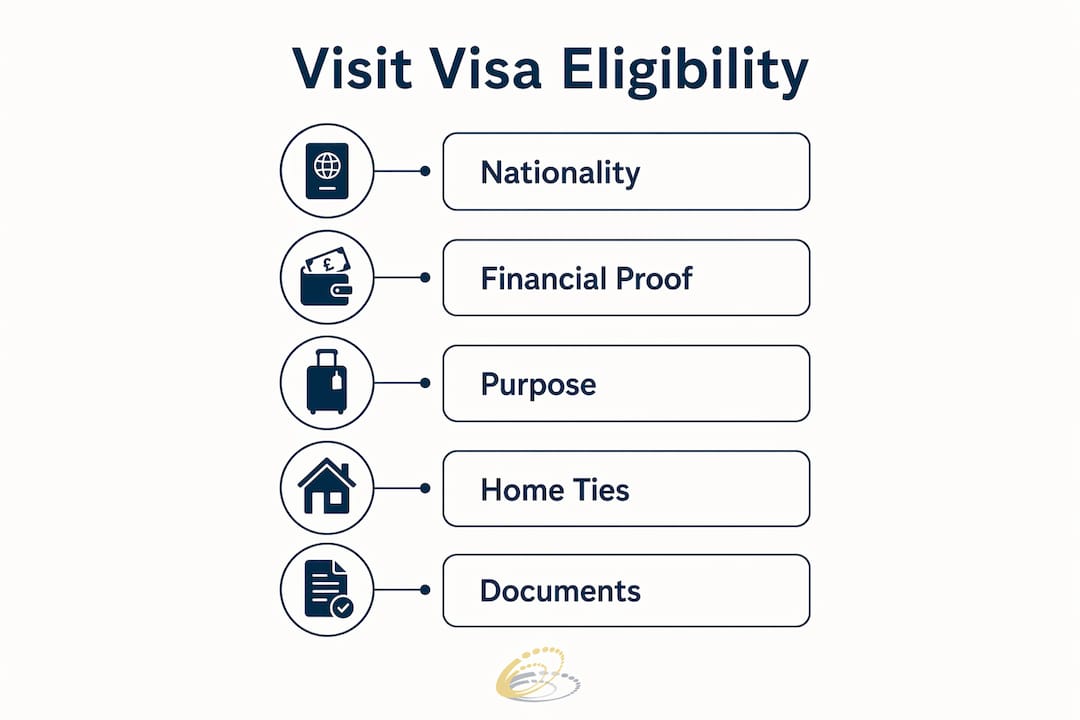
A UK visit visa is defined as official permission for foreign nationals to enter the United Kingdom for a temporary, short-term stay without taking up employment or settlement. The Standard Visitor visa is the primary route for tourism, family visits, business meetings, and medical treatment. To meet visit visa eligibility requirements explained under the Immigration Rules (Appendix V), you must prove genuine visit intent, sufficient funds, and strong ties to your home country. Getting these three pillars right determines whether your application succeeds or fails.
Who needs a visit visa or ETA to enter the UK?
Entry requirements depend entirely on your nationality. The UK divides travellers into three groups, each with different obligations before arrival.
Visa nationals must apply for a Standard Visitor visa before travel, ETA nationals require an Electronic Travel Authorisation, and visa-free nationals need no prior permission but must still meet eligibility conditions at the border.
- Visa nationals submit a full visa application to the Home Office, provide biometric data, and await a decision before booking travel.
- ETA nationals apply for a digital pre-clearance. The ETA lasts up to two years or until passport expiry, whichever comes first. A refused ETA means you must apply for a full visa instead.
- Visa-free nationals travel without advance permission but face the same eligibility checks at the UK border. Officers can refuse entry if you cannot demonstrate a genuine, temporary visit.
- EEA and Swiss citizens may use ePassport gates for faster processing, but the same visitor rules apply to them.
Check the official UK government nationality checker before making any travel plans. The list of visa nationals and ETA nationals changes, and travelling under the wrong assumption leads to denied boarding or refusal at the border.
Pro Tip: If your ETA application is refused, do not rebook immediately. A refusal creates a record. Seek legal advice before submitting a full visa application to avoid compounding the problem.
Core visit visa eligibility requirements explained

The Standard Visitor visa permits a stay of up to six months for most purposes. Longer stays apply in specific cases: up to 11 months for private medical treatment and up to 12 months for academic sabbaticals. These are exceptions, not the norm.
To qualify, you must satisfy all of the following criteria:
- Genuine visit purpose. Your reason for visiting must fall within the permitted activities list under Appendix V of the Immigration Rules. Tourism, family visits, business meetings, short study courses, cultural activities, and private medical treatment all qualify. Purposes outside this list result in refusal.
- Sufficient funds. You must cover all reasonable costs of your trip without accessing UK public funds. No fixed minimum amount applies, but bank statements must show a consistent, credible financial picture.
- Strong home ties. Employment, property ownership, family responsibilities, or ongoing education in your home country all demonstrate your intention to return. Weak ties are the leading cause of refusal.
- Valid travel documents. Your passport must be valid for the duration of your stay and contain sufficient blank pages for entry stamps.
- No intention to settle or work. You must not plan to live in the UK, take up employment, or breach any condition of the visit visa.
The Home Office assesses all five criteria together. Meeting four out of five is not enough. A caseworker who doubts your intention to leave will refuse the application regardless of your financial position.
What documents do you need to prove eligibility?
Documentation is where most applications succeed or fail. Caseworkers look for a coherent, consistent narrative. Every document must support the same story.
- Bank statements. Provide at least three months of recent statements. Large unexplained deposits shortly before the application date raise immediate suspicion. Caseworkers scrutinise the origin and timeline of funds carefully.
- Payslips and employment letter. Your employer should confirm your job title, salary, length of service, and the dates of your approved leave. This document serves double duty: it proves funds and demonstrates a reason to return home.
- Travel itinerary and accommodation. Provide a day-by-day plan of your visit, hotel bookings, or a confirmed address where you will stay. Vague itineraries suggest an unclear or dishonest purpose.
- Return ticket. A confirmed return booking shows you plan to leave. It is not mandatory, but its absence invites questions.
- Invitation letter (where applicable). If staying with a UK host, ask them to write a letter confirming the invitation, their address, and their relationship to you. Attach their proof of status or settled status if available.
- Evidence of home ties. Property deeds, tenancy agreements, birth certificates of dependants, university enrolment letters, or business ownership documents all work. The stronger and more varied the evidence, the better.
Pro Tip: Do not submit every document you own. Inconsistent or excessive documentation that does not form a coherent narrative damages your application. Select documents that tell one clear, truthful story.
Third-party sponsorship requires full disclosure. If someone else is funding your trip, provide their bank statements, a signed sponsorship letter, and evidence of their relationship to you. Undisclosed sponsorships are treated as deception.
What can you do on a UK visit visa?
The Standard Visitor visa permits a defined range of activities. Staying within those boundaries protects your immigration record for all future applications.
Permitted activities include:
- Tourism and leisure travel
- Visiting family or friends
- Attending business meetings, conferences, or negotiations (but not working for a UK employer)
- Short study courses of up to 30 days
- Private medical treatment
- Cultural, religious, or sporting activities as a participant, not a professional
Prohibited activities include:
- Paid or unpaid work for any UK company or individual
- Volunteering or internships that substitute for paid employment
- Enrolling in a long-term course of study
- Accessing public funds such as NHS treatment beyond emergency care or benefits
Visitors cannot undertake paid or unpaid work, including volunteering or internships, on a visit visa. Even minor unauthorised work creates a negative immigration history that raises the evidential burden for every subsequent visa application.
One narrow exception exists: the Permitted Paid Engagement route. This allows specific professionals, such as academics giving a lecture or artists performing at a one-off event, to receive payment from a UK organisation. The engagement must be pre-arranged and fall within a tightly defined list. It does not apply to general employment.
The Home Office enforces the work prohibition rigorously. Remote working for a foreign employer while in the UK sits in a grey area, but working for a UK company, even unpaid, is a clear breach. The consequences extend well beyond the current visit.
How do you demonstrate strong ties to your home country?
Lack of strong home ties is the most common reason for visit visa refusal. A caseworker who cannot see a compelling reason for you to return home will assume you intend to overstay.
Strong ties fall into four categories:
- Employment. A permanent or long-term job with an employer who has confirmed your leave is the most persuasive tie. Self-employed applicants should provide business registration documents, client contracts, and tax records.
- Family responsibilities. Dependent children, elderly parents in your care, or a spouse who is not travelling with you all demonstrate roots. Provide birth certificates, marriage certificates, or care arrangements as evidence.
- Property or tenancy. Owning a home or holding a tenancy agreement in your name shows a financial and practical commitment to returning. Provide deeds or a signed lease.
- Ongoing education. Students enrolled in a course at home have a clear, documented reason to return. Provide an enrolment letter and timetable.
Generic or vague evidence raises suspicion. A letter that simply states “I am employed” without specifying salary, leave dates, or job title tells a caseworker very little. Specificity signals credibility. The application process strongly favours documented ties and a logical timeline that matches your stated purpose and itinerary.
If your ties are genuinely limited, for example you are between jobs or recently graduated, be honest and compensate with stronger financial evidence and a detailed itinerary. Attempting to fabricate ties is grounds for a long-term ban.
Key takeaways
A successful UK visit visa application depends on proving genuine intent, consistent financial evidence, and strong home ties across every document you submit.
| Point | Details |
|---|---|
| Nationality determines entry route | Visa nationals apply in advance; ETA nationals need digital pre-clearance; visa-free nationals face border checks. |
| Three core eligibility pillars | Genuine visit purpose, sufficient funds, and strong home ties must all be satisfied simultaneously. |
| Document quality over quantity | A coherent, consistent set of documents outperforms a large, contradictory bundle every time. |
| Work prohibition is absolute | Any paid or unpaid work, including volunteering, breaches visit visa conditions and harms future applications. |
| Home ties are the top refusal cause | Specific, documented evidence of employment, property, or family responsibilities is the strongest defence against refusal. |
What I have learned from handling visit visa cases
Working through visit visa applications over many years, one pattern stands out above all others. Applicants focus intensely on financial proof and almost entirely neglect the home ties question. They submit six months of bank statements and forget to include the employment letter that explains why those funds exist and why they will return to earn more.
The second most common error is the inconsistent narrative. An applicant states they are visiting for tourism, then submits a letter from a UK business contact. A caseworker reads that as a potential work visit. The documents do not lie, but they do not agree either. Refusal follows.
I have also seen applicants submit far too much. A 200-page bundle with every bank statement from the past three years, every utility bill, and every photograph from a previous visit does not impress a caseworker. It creates confusion. The consistency of documentation and a truthful, coherent narrative improve success rates far more than volume.
My strongest advice: treat your application as a short, factual story. Every document is a sentence in that story. If a document does not support the plot, leave it out. If a document contradicts the plot, address it directly in your covering letter rather than hoping the caseworker misses it. They will not.
— michelle
How Mnssolicitors can help with your visitor visa application
Applying for a UK visitor visa without professional guidance means navigating Appendix V of the Immigration Rules, Home Office evidential standards, and a document checklist that shifts with policy updates. One oversight can result in refusal and a damaged immigration record.
Mnssolicitors specialises in UK visitor visa applications, with every case handled by a qualified solicitor from the first enquiry. The firm offers fixed, transparent pricing with no hidden fees, and a fast-track service that can prepare a full application in as little as 24 hours for urgent cases. With over 170 five-star Google reviews, Mnssolicitors has a proven record of guiding clients through complex eligibility questions, document preparation, and submission. Contact Mnssolicitors today for a consultation and get your application right the first time.
FAQ
What is a Standard Visitor visa?
The Standard Visitor visa is the UK’s primary short-term entry route for tourism, family visits, business meetings, and medical treatment. It permits stays of up to six months under Appendix V of the Immigration Rules.
How much money do I need to show for a UK visit visa?
No fixed minimum amount applies. You must demonstrate sufficient funds to cover all reasonable trip costs without recourse to public funds, supported by recent bank statements and payslips.
What is the most common reason for visit visa refusal?
Lack of strong home ties is the leading cause of refusal. Caseworkers must be satisfied that you have compelling reasons, such as employment, property, or family, to return home after your visit.
Can I work remotely for my foreign employer while on a UK visit visa?
Working for a UK employer, paid or unpaid, is prohibited. Remote work for a foreign employer sits in a grey area, but any activity that resembles employment for a UK entity risks breaching your visa conditions.
Do I need a visa if I hold an EU passport?
EEA and Swiss citizens do not need a Standard Visitor visa but must meet the same eligibility conditions at the UK border. They may use ePassport gates for faster processing, but entry is not guaranteed.
Leave a Reply