
UK family visa categories are the defined legal routes under which individuals can join qualifying family members who are settled or resident in the United Kingdom. Governed primarily by Appendix FM of the Immigration Rules, these routes cover partners, children, parents, and adult dependent relatives. Each category carries distinct eligibility criteria, financial thresholds, and procedural requirements. Understanding which route applies to your situation is the first step toward a successful family visa application in the UK.
What are the main UK family visa categories?
The UK family immigration system organises eligibility into four principal routes, each targeting a specific family relationship. Knowing which category applies to you determines the evidence you must gather, the fees you will pay, and the settlement path available to you.
The main family visa routes cover the following categories:
- Partner visas cover spouses, civil partners, unmarried partners, and fiancé(e)s of British citizens or settled persons. Unmarried partners must demonstrate a durable relationship of at least two years. Fiancé(e) visas allow entry to marry in the UK within six months, after which the applicant switches to a spouse visa.
- Parent visas apply to parents who have sole or shared parental responsibility for a child who is British or settled in the UK. The child must be under 18 and living in the UK. The parent must not be in a relationship with the other parent of the child.
- Child visas allow children under 18 to join a parent who is settled or has limited leave in the UK. The child must not be leading an independent life, and both parents must either be settled or one must be the sole surviving parent.
- Adult Dependent Relative visas are the most restrictive category. Applicants must demonstrate that they require long-term personal care due to illness, disability, or age, and that this care is not available or affordable in their home country.
- Bereaved partner and domestic violence concessions exist as special routes for those whose relationship ended due to the death of their sponsor or due to domestic abuse. These routes protect vulnerable individuals from losing their immigration status.
Each route leads to either a five-year or ten-year path to Indefinite Leave to Remain, depending on whether all eligibility requirements are met.
What are the key eligibility criteria for UK family visa applications?

Eligibility under UK family immigration law rests on four pillars: relationship, finances, accommodation, and English language. Failing any one of these pillars is sufficient grounds for refusal.
The eligibility requirements are structured as follows:
- Relationship requirement. The relationship must be genuine and subsisting. For spouses and civil partners, a valid marriage or civil partnership certificate is required. Unmarried partners must prove a two-year durable relationship through evidence of cohabitation, shared finances, and social proof such as joint correspondence.
- Financial requirement. The sponsor must meet a minimum gross annual income of £29,000 in 2026. This threshold applies to most partner visa applications. Income thresholds increase when dependant children are included in the application, and the type of income, whether from employment, self-employment, or savings, determines which evidence category under Appendix FM-SE applies.
- Accommodation requirement. The sponsor must show that adequate accommodation exists for the family without recourse to public funds. Evidence typically includes a tenancy agreement, mortgage statement, or a letter from the property owner confirming available space.
- English language requirement. Most adult applicants must demonstrate English language ability at level A1 or above on the Common European Framework of Reference. This can be satisfied through an approved Secure English Language Test, a degree taught in English, or by being a national of a majority English-speaking country.
- Sponsor eligibility. Sponsor categories include British citizens, persons with Indefinite Leave to Remain, refugees, and those with humanitarian protection status. The sponsor must not be subject to a deportation order or have a criminal record that renders them unsuitable.
Pro Tip: If your income falls slightly below £29,000, check whether cash savings can be used to make up the shortfall. Appendix FM-SE permits savings above £16,000 to be counted towards the financial requirement under specific conditions.
How does the application process work?
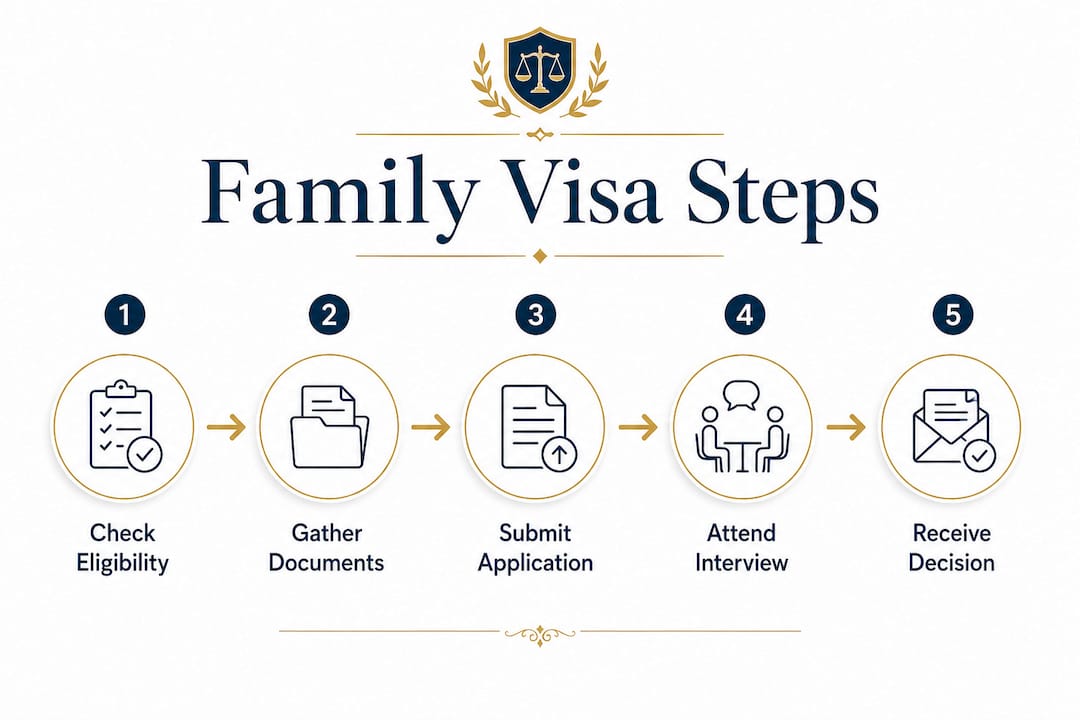
The application process differs depending on whether you are applying from outside the UK (entry clearance) or from within the UK (leave to remain). Both routes require the same core evidence but follow different procedural steps and fee structures.
Applicants from outside the UK submit their application online through the UK Visas and Immigration portal, attend a biometric appointment at a Visa Application Centre, and await a decision. Standard fees from outside the UK total £1,938 for the visa itself, plus an Immigration Health Surcharge of £1,035 per year of leave granted. Together, these costs exceed £2,970 for a standard application in 2026.
The evidence required varies by income category under Appendix FM-SE:
- Category A covers salaried employment. Evidence includes six months of payslips and a letter from the employer confirming salary and contract type.
- Category B applies to variable income. Evidence must cover twelve months of payslips and bank statements.
- Category C covers non-employment income such as rental income or dividends, requiring twelve months of evidence.
- Category D and E cover cash savings and pension income respectively, each with specific documentation requirements.
- Categories F and G apply to self-employed applicants and company directors, requiring tax returns, business accounts, and HMRC correspondence.
Relationship evidence must demonstrate that the relationship is genuine. This includes photographs together, communication records, travel history showing visits, and declarations from family or friends.
| Evidence type | Examples |
|---|---|
| Relationship proof | Photographs, communication records, joint travel history |
| Financial proof | Payslips, bank statements, employer letter, tax returns |
| Accommodation proof | Tenancy agreement, mortgage statement, property letter |
| English language proof | SELT certificate, degree transcript, passport (qualifying nationals) |
Transitional financial rules applied to applications submitted before 11 april 2024, when the income threshold was £18,600. Applications made after that date must meet the current £29,000 threshold.
What are the routes to settlement under UK family migration law?
Settlement in the UK through the family route follows either a five-year or ten-year path, depending on whether the applicant meets all requirements under Appendix FM.
The five-year route to ILR applies when the applicant satisfies all financial, relationship, and eligibility requirements throughout their leave. After completing five years of limited leave in the UK, the applicant can apply for Indefinite Leave to Remain.
The ten-year route applies when an applicant cannot meet the financial requirement but can demonstrate that refusing leave would breach their rights under Article 8 of the European Convention on Human Rights. Article 8 protects the right to respect for private and family life. This route requires a detailed legal argument showing that the interference with family life is disproportionate.
The ten-year route to ILR is a human rights-based fallback. It requires robust legal argument and detailed evidence of exceptional circumstances and the impact on family life. It is not a simple alternative to the standard route; it demands a higher standard of proof and specialist legal support.
Key distinctions between the routes include:
- Partners and parents on the five-year route must maintain the financial requirement at each renewal stage.
- Applicants on the ten-year route must demonstrate exceptional circumstances at every application stage, not just at the outset.
- Children granted leave as dependants follow the same route as their parent applicant.
- The Adult Dependent Relative route is unique in that it grants ILR on the first grant of leave, subject to conditions being met at the time of application.
What challenges do applicants face in UK family visa categories?
The most common cause of refusal in family visa applications is incorrect income evidence. Misclassifying income under the wrong Appendix FM-SE category is a leading ground for refusal, particularly for self-employed applicants and company directors whose income streams do not fit neatly into a single category.
Relationship evidence presents a separate challenge, especially for unmarried partners. Caseworkers assess whether the relationship is genuine and subsisting based on the totality of evidence. Gaps in cohabitation history or inconsistent financial records can raise doubts, even where the relationship is entirely genuine.
Transitional rules add further complexity. Applicants who began their leave under the old £18,600 threshold may face different requirements at renewal if their circumstances have changed. Benefit receipt by the sponsor can also affect eligibility in certain cases, as the financial requirement must be met independently of public funds.
Article 8 claims require a particularly high standard of evidence. Applicants must show not only that family life exists but that the consequences of refusal are disproportionate. This involves detailed witness statements, medical evidence where relevant, and often expert legal submissions.
Pro Tip: Seek specialist legal advice before submitting any application where income is self-employed, variable, or drawn from multiple sources. The seven income categories in Appendix FM-SE require precise documentation, and a single missing document can result in refusal.
Key takeaways
The most reliable path through UK family visa categories is a thorough understanding of Appendix FM, correct income categorisation, and complete relationship evidence from the outset.
| Point | Details |
|---|---|
| Four main visa categories | Partner, parent, child, and adult dependent relative routes each have distinct eligibility rules. |
| Financial threshold in 2026 | Sponsors must earn at least £29,000 gross per year, with higher thresholds when dependants are included. |
| Two settlement routes | The five-year route requires full eligibility; the ten-year route applies where Article 8 rights are engaged. |
| Income evidence is critical | Misclassifying income under Appendix FM-SE is the leading cause of refusal, especially for self-employed applicants. |
| Adult Dependent Relative route | This category grants ILR on the first grant but carries the strictest eligibility criteria of all family routes. |
What I have learned from watching family visa cases go wrong
Having reviewed a significant number of family visa cases over the years, the pattern that stands out most is not the complexity of the law itself. It is the gap between what applicants believe they need to submit and what the Home Office actually requires.
The financial requirement is where most cases unravel. Applicants often assume that showing a bank balance is sufficient. Appendix FM-SE does not work that way. The rules require income to be evidenced in a specific format, from specific sources, covering a specific period. A payslip from the wrong month, or a bank statement that does not correspond to the payslip dates, can be enough to trigger a refusal.
The second pattern I see repeatedly is underestimating the relationship evidence requirement for unmarried partners. Two years of cohabitation must be demonstrated, not simply asserted. Caseworkers look for corroborating evidence across multiple categories, not a single piece of documentation.
My strongest advice is this: consult a qualified solicitor before you submit, not after you receive a refusal. Refusals create a record that can complicate future applications. Getting the application right the first time is always less costly, financially and emotionally, than appealing a refusal. The role of your sponsor in the application is also frequently misunderstood, and that misunderstanding alone can derail an otherwise strong case.
— michelle
How Mnssolicitors supports family visa applicants
Mnssolicitors specialises in UK family immigration law, with direct experience across all categories under Appendix FM. Every enquiry is handled by a qualified solicitor from the outset, not a trainee or paralegal.
Whether you are applying for a spouse or partner visa, seeking advice on the ten-year route under Article 8, or preparing for a settlement application, Mnssolicitors provides clear, fixed-fee guidance with no hidden costs. The firm offers a fast-track service capable of preparing applications in as little as 24 hours for urgent cases. With over 170 five-star Google reviews, Mnssolicitors has a proven record of supporting clients through the most complex family immigration situations. Contact Mnssolicitors today for a free initial consultation and get the right advice before you apply.
FAQ
What is Appendix FM in UK family visa law?
Appendix FM is the section of the UK Immigration Rules that governs all family visa applications. It sets out eligibility, suitability, and procedural requirements for partners, parents, children, and adult dependent relatives.
What is the minimum income for a UK family visa in 2026?
The sponsor must earn at least £29,000 gross per year. This threshold increases when dependant children are included in the application.
How long does it take to get Indefinite Leave to Remain on a family visa?
The standard route takes five years of continuous limited leave. Applicants who cannot meet the financial requirement but qualify under Article 8 follow a ten-year route to ILR.
Can unmarried partners apply for a UK family visa?
Yes. Unmarried partners can apply under Appendix FM provided they can demonstrate a genuine and subsisting relationship of at least two years, evidenced through cohabitation, shared finances, and other supporting documentation.
What happens if a family visa application is refused?
Applicants have the right to appeal a refusal to the First-tier Tribunal (Immigration and Asylum Chamber). In some cases, a judicial review may be appropriate. Seeking specialist legal advice promptly after a refusal is strongly recommended.
Leave a Reply