
A family visa extension is a formal application to the Home Office that allows eligible family members to continue living lawfully in the UK beyond their initial leave period. Understanding how family visa extension works is the first step to protecting your family’s right to remain together. Most applicants on a spouse or partner visa receive an initial 30 or 33-month visa, and extending before expiry is the only way to maintain continuous, lawful residence. A successful extension typically grants a further 2.5 years on the family route, with Section 3C of the Immigration Act protecting your rights while the Home Office processes your application.
How does a family visa extension work in the UK?
The family visa renewal process operates under the UK’s points-based immigration framework, governed by Appendix FM of the Immigration Rules. You apply to extend your leave before your current visa expires, prove you still meet all the original eligibility criteria, and demonstrate that your family life in the UK is genuine and continuing. The Home Office then assesses your application against the same core standards used at the initial stage, though some requirements become slightly more demanding the second time around.
The extension is not automatic. You must actively submit a new application, pay the relevant fees, and provide fresh evidence covering the period since your last visa was granted. Families who treat the extension as a formality often face refusals because they underestimate how much the Home Office scrutinises relationship continuity at this stage.

What are the eligibility criteria for a family visa extension?
Meeting the eligibility criteria is the foundation of any successful application. The requirements cover your relationship, finances, accommodation, and English language ability.
Relationship
Your relationship with your UK-settled sponsor must remain genuine and subsisting. The Home Office expects to see evidence of a shared life, not simply a legal marriage certificate. You must prove the relationship has continued since your initial visa was granted.
Financial threshold
The minimum combined income threshold is £29,000. At the extension stage, the applicant’s UK income can be combined with the sponsor’s income to reach this figure. This is a significant advantage over the initial application, where only the sponsor’s income counted. Families where the sponsor’s salary alone falls short should calculate the combined household income carefully before applying.
English language
The English language requirement increases at extension stage. CEFR level A2 is required, one level above the A1 standard needed for the initial visa. You must pass a Secure English Language Test (SELT) from an approved provider unless you qualify for an exemption based on age, nationality, or disability.
Accommodation and character
Your accommodation must be adequate for the whole family without recourse to public funds. You must also declare any criminal convictions and confirm you have not breached any immigration conditions.
Key eligibility checklist:
- Genuine and subsisting relationship with your sponsor
- Combined household income of at least £29,000
- English language at CEFR A2 level (or valid exemption)
- Adequate accommodation that does not overcrowd
- No serious criminal convictions or immigration breaches
- Continuous lawful residence since the initial visa was granted
Pro Tip: If your sponsor’s income alone does not reach £29,000, add your own UK earnings to the calculation. Many families miss this option and assume they do not qualify.
How and when should you apply for a family visa extension?
Timing your application correctly is as important as meeting the eligibility criteria. Applying around 28 days before your visa expires is the recommended approach. Applying too early reduces the qualifying residence time you accumulate towards Indefinite Leave to Remain (ILR). Applying too late risks an overstay, which carries serious immigration consequences.
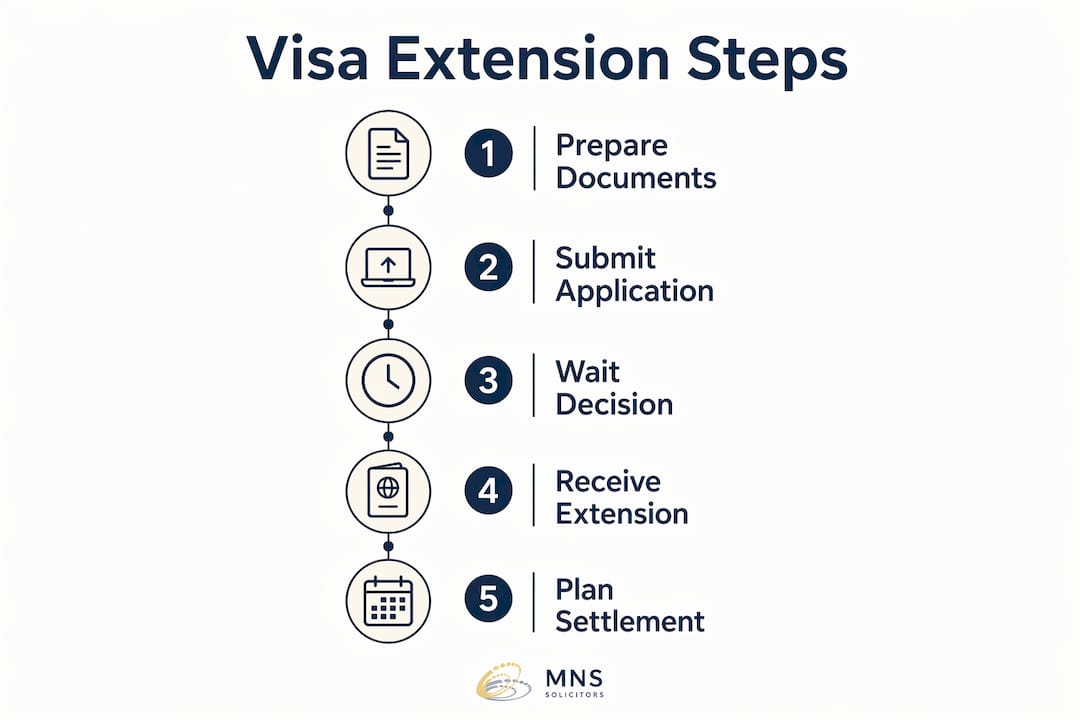
The step-by-step process for most spouse and partner visa holders is as follows:
- Check your visa expiry date. Calculate 28 days before expiry and set that as your target submission date.
- Complete form FLR(M). This is the correct form for spouse, civil partner, and unmarried partner visa extensions. Submit it through the GOV.UK online application portal.
- Pay the application fee and Immigration Health Surcharge. Both must be paid at the time of submission. The surcharge covers NHS access during your extended leave.
- Book a biometrics appointment. Use a UK Visa and Citizenship Application Services (UKVCAS) centre or, where eligible, the Identity Document Verification (IDV) app to submit your biometric data.
- Submit your supporting documents. Upload all evidence through the online portal or bring it to your appointment as instructed.
- Await a decision. Standard processing takes 8–12 weeks. Priority service reduces this to approximately 5 working days, and super priority can deliver a decision by the next working day.
Section 3C of the Immigration Act protects your leave while the application is pending, provided you applied before your current visa expired. You retain the right to live and work in the UK throughout this period.
Pro Tip: Do not travel outside the UK while your extension application is pending. Leaving the country before a decision is made can invalidate your Section 3C protection and jeopardise your application.
What evidence do you need for a family visa extension application?
Strong evidence is what separates approved applications from refused ones. The Home Office expects documentation that covers the full period since your last visa was granted, not just recent months.
Relationship evidence
You must show that your relationship is genuine and continuing. Accepted evidence includes:
- Recent photographs of you and your partner together, ideally dated and showing different occasions
- Joint utility bills, bank statements, or tenancy agreements showing a shared address
- Correspondence addressed to both of you at the same address
- Evidence of shared financial commitments, such as joint savings or shared household expenses
- Communication records such as call logs or messages if you have spent time apart
Evidence must cover the period since your last visa grant. A handful of recent photos is not sufficient. The Home Office looks for a consistent, documented pattern of shared life.
Financial evidence
Payslips covering the most recent six months, bank statements, and an employer letter confirming your contract and salary are the standard requirements. Self-employed applicants must provide tax returns, business accounts, and evidence of ongoing contracts. If you are using savings to meet the financial threshold, you will need bank statements showing the funds held for at least six months.
Accommodation evidence
A tenancy agreement, mortgage statement, or letter from your landlord confirming the property address and the names of all occupants is required. Utility bills addressed to your home can supplement this.
English language and other documents
Your SELT certificate from an approved test centre must be included unless you hold an exemption. You will also need your current and previous passports, your BRP card, and any criminal record declarations required by the application form.
Pro Tip: Keep a dedicated folder throughout your visa period and add relationship evidence regularly. Families who do this find the documentation stage straightforward. Those who try to reconstruct two years of shared life in a week often miss critical gaps.
What happens after you apply, and how do you plan for settlement?
Once you submit your application before your visa expires, Section 3C leave takes effect automatically. You continue to hold the same rights as your current visa, including the right to work, study, and access NHS services. Your BRP card may show an expired date, but your Section 3C status is confirmed by your application reference number.
Avoid international travel during this period. Leaving the UK while your application is pending ends your Section 3C protection. If you must travel, seek legal advice before booking any flights.
When the Home Office approves your extension, you receive a further 2.5 years of leave on the family route. After accumulating 5 years on the family route, you become eligible to apply for Indefinite Leave to Remain (ILR). ILR is the gateway to permanent residence and, eventually, British citizenship.
Planning for ILR should begin well before the five-year mark. The table below summarises the key milestones and requirements on the family route to settlement.
| Stage | Requirement | Notes |
|---|---|---|
| Initial visa | A1 English, £29,000 sponsor income | 30 or 33 months leave granted |
| First extension | A2 English, £29,000 combined income | Further 2.5 years leave granted |
| ILR application | B1 English, Life in the UK test | After 5 years on family route |
| Absence limits | No more than 180 days per year | Counted across the qualifying period |
| Citizenship | B1 English, Life in the UK test | Typically 1 year after ILR |
The ILR application requires a higher English level of B1, a pass in the Life in the UK test, and compliance with absence limits throughout the qualifying period. Families who travel frequently should track their absences carefully from the very start of their first visa.
Key takeaways
A successful family visa extension depends on applying at the right time, meeting the financial and English language thresholds, and providing thorough relationship evidence that covers the entire period since the last visa was granted.
| Point | Details |
|---|---|
| Apply 28 days before expiry | This timing maximises qualifying residence time towards ILR without risking an overstay. |
| Combine household incomes | At extension stage, both applicant and sponsor UK income count toward the £29,000 threshold. |
| English level increases | A2 CEFR is required at extension, one level above the A1 needed for the initial visa. |
| Section 3C protects your rights | Applying before expiry keeps your leave valid while the Home Office processes your application. |
| Plan for ILR from day one | Five years on the family route leads to ILR eligibility, but absences and English levels must be managed throughout. |
What I have learned from working with family visa extension cases
The most common mistake I see is families treating the extension as a repeat of the initial application. It is not. The Home Office expects more at this stage, not less. The relationship evidence must be richer, the English level is higher, and the financial calculation is different. Families who prepare as if nothing has changed often receive requests for further information or, worse, refusals.
The timing point is one that genuinely surprises people. Applying too early is not just unnecessary; it actively costs you qualifying residence time towards ILR. I have seen applicants submit their extension three or four months before expiry because they were anxious, only to realise later that those extra months did not count towards their five-year total. Applying around 28 days before expiry is not a risk. It is the correct strategy.
The income combination rule at extension stage is another area where families leave money on the table. Many assume the financial requirement works the same way as the initial application, where only the sponsor’s income counted. At extension stage, your own UK earnings count too. For families where the sponsor works part-time or has a modest salary, this can be the difference between approval and refusal.
My strongest advice is to start gathering evidence from the day your initial visa is granted. Photograph your life together regularly. Keep joint documents in one place. Do not wait until three months before your extension is due to reconstruct two years of shared history. The families who do this find the process straightforward. The ones who do not find it stressful and expensive.
— michelle
How Mnssolicitors can support your family visa extension
Mnssolicitors specialises in spouse visa extensions and the full range of family immigration matters. Every case is handled by a qualified solicitor from the first contact, not a trainee or paralegal. That means your extension application is assessed by someone who understands the Home Office’s expectations and knows where applications commonly fall short.

Mnssolicitors offers fixed, transparent pricing with no hidden fees, so you know the full cost before any work begins. For families facing urgent deadlines, a fast-track service can prepare a complete application in as little as 24 hours. With over 170 five-star Google reviews, the firm has a strong record of guiding families through the extension process successfully. Contact Mnssolicitors for a free initial consultation to discuss your circumstances and get clear advice on your next steps.
FAQ
How long does a family visa extension take to process?
Standard processing takes 8–12 weeks. Priority service delivers a decision in approximately 5 working days, and super priority by the next working day.
Can I work while my family visa extension is being processed?
Yes. Provided you applied before your current visa expired, Section 3C of the Immigration Act keeps your existing rights, including the right to work, valid throughout the processing period.
What is the financial requirement for a family visa extension?
The minimum income threshold is £29,000. At extension stage, the applicant’s own UK earnings can be combined with the sponsor’s income to reach this figure, which differs from the initial application rules.
What English level do I need for a family visa extension?
You need CEFR level A2, demonstrated through a Secure English Language Test from an approved provider. This is one level above the A1 required for the initial visa, unless you qualify for an exemption.
What happens if my family visa expires before I apply?
Applying after your visa has expired means you lose Section 3C protection and risk being treated as an overstayer. An overstay carries serious consequences for any future immigration applications and should be addressed with legal advice immediately.
Leave a Reply