
The role of a sponsor in a UK family visa application is to formally support a family member’s entry or settlement by providing evidence of eligibility, financial capacity, accommodation, and genuine relationship. UK Visas and Immigration (UKVI) assesses the sponsor, not just the applicant, making the sponsor’s legal status and documentation central to the outcome. Whether you are sponsoring a spouse, child, or adult dependent relative, your ability to meet defined criteria under Appendix FM of the Immigration Rules determines whether your family can be reunited. Understanding what UKVI expects from you as a sponsor is the first step to a successful application.
What eligibility requirements must a UK family visa sponsor meet?
A sponsor must hold a qualifying immigration status in the UK before they can support a family visa application. UKVI requires clear evidence that sponsors hold eligible immigration status and lawful residence to sponsor family visa applicants. This means you must be a British citizen, hold Indefinite Leave to Remain, have settled status under the EU Settlement Scheme, or hold another qualifying status recognised under Appendix FM.
Beyond status, your legal conduct matters. Sponsors must not have breached any immigration laws during their time in the UK, as UKVI assesses immigration history when considering sponsorship eligibility. A single serious breach can undermine an otherwise strong application.
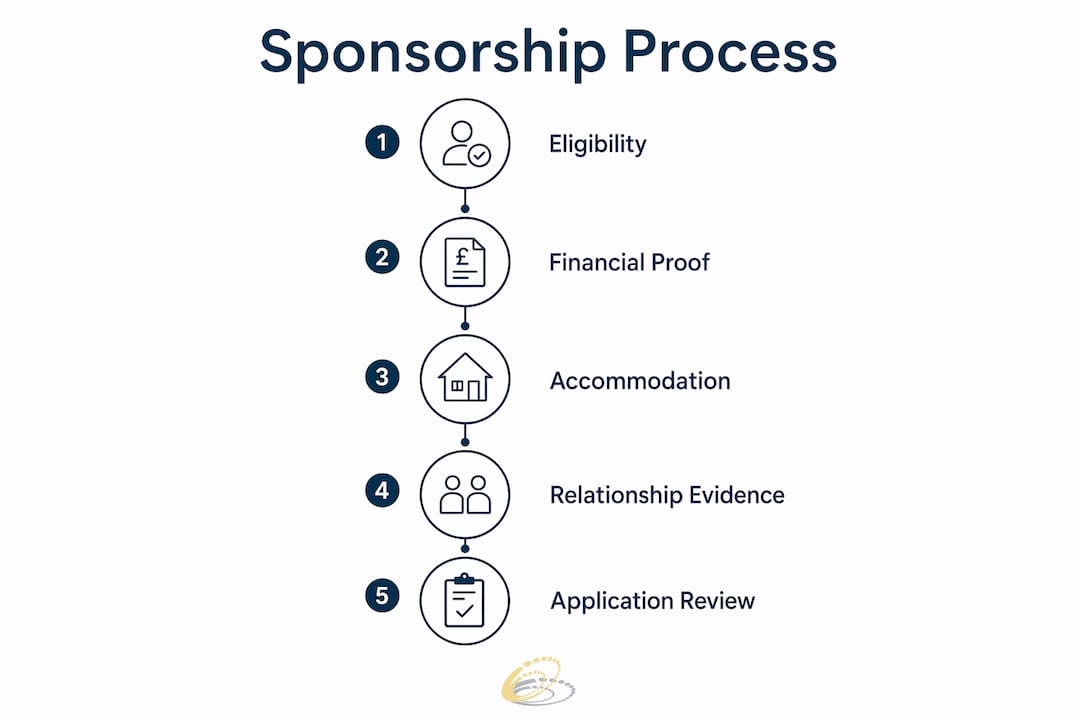
The core eligibility criteria for a UK family visa sponsor are:
- UK citizenship, settled status, or qualifying immigration leave confirmed by a valid passport, biometric residence permit, or Home Office letter
- Proof of lawful residence such as utility bills, council tax statements, or a mortgage agreement in your name
- Financial capacity to meet either the minimum income threshold or the adequate maintenance test
- Accommodation that meets Housing Act 1985 standards without overcrowding
- Clean immigration record with no recent breaches, overstays, or deception findings
Pro Tip: Gather your proof of address documents from at least two different sources, such as a bank statement and a utility bill, to give UKVI a consistent picture of your residence.
The financial requirement is the criterion that most sponsors find demanding. Under the spouse and partner visa route, a minimum gross annual income applies. For other routes, such as adult dependent relatives, the adequate maintenance test replaces the income threshold entirely.
How does a sponsor demonstrate financial capacity and accommodation?
Financial capacity is demonstrated through a combination of income evidence and, where applicable, a formal maintenance undertaking. Financial proofs must include employer’s letters, payslips over six months, bank statements, and for cash savings, six months of bank statements plus a source declaration. These requirements sit under Appendix FM-SE, the evidential rules that govern financial assessment for UK family visas.

The adequate maintenance test applies when the standard income threshold does not. For sponsors receiving benefits like Carer’s Allowance or Disability Living Allowance, the income threshold is waived in favour of an adequate maintenance test, requiring a signed maintenance undertaking Form SU07. This test asks whether the sponsor’s disposable income, after housing costs and existing commitments, covers the applicant’s needs without recourse to public funds.
| Document type | Purpose | Notes |
|---|---|---|
| Six months’ payslips | Proves consistent employment income | Must be from the same employer |
| Employer’s letter | Confirms salary and contract type | Should be on headed paper |
| Six months’ bank statements | Shows income received and outgoings | Must match payslip figures |
| Form SU07 | Maintenance undertaking for certain routes | Required for adult dependent relative route |
| Savings statements | Evidences cash savings above threshold | Six months’ history required |
Accommodation is assessed separately but equally strictly. The accommodation must be owned or exclusively occupied by the family without overcrowding, in compliance with Housing Act 1985 standards. Living rooms may count as bedrooms when calculating room numbers, but kitchens and bathrooms do not. You will need to provide a mortgage statement or tenancy agreement, and if you rent, your landlord’s written permission for the applicant to live there.
Pro Tip: If you rent, ask your landlord for a letter confirming the applicant can reside at the property before you submit the application. UKVI will expect this, and its absence can cause delays.
The sponsor’s income must cover their household and the applicant’s maintenance and accommodation costs, with enough disposable income remaining to avoid any reliance on public funds. This is not simply a matter of meeting a headline figure. UKVI looks at net disposable income after outgoings, so a high salary with significant debt obligations may still fall short.
What evidence is required to prove the sponsor-applicant relationship?
Proving the relationship is as important as proving financial capacity. The sponsor-applicant relationship must be evidenced by consistent, official documents such as marriage or birth certificates to meet UKVI credibility standards. Inconsistencies between documents, or between documents and the application form, are a common reason for refusal.
The documents required depend on the relationship type:
- Spouse or civil partner: original marriage certificate or civil partnership certificate, translated into English if not already
- Unmarried partner: evidence of cohabitation for at least two years, such as joint tenancy agreements, shared bank statements, or correspondence addressed to both parties at the same address
- Child: birth certificate naming the sponsor as parent, and if applicable, adoption papers or a court order confirming parental responsibility
- Adult dependent relative: medical evidence of care needs, evidence of the sponsor’s ability to meet those needs, and proof that adequate care is not available in the applicant’s home country
Supporting evidence of financial dependency strengthens applications where the relationship is not immediately obvious from a single document. For example, a sponsor who has been sending regular remittances to an elderly parent abroad should include bank transfer records spanning at least 12 months. This demonstrates both the relationship and the financial link.
Consistency across all documents is non-negotiable. If your marriage certificate spells your name differently from your passport, you must provide a statutory declaration or deed poll to explain the discrepancy. UKVI will not resolve ambiguities in your favour without explanation. A thorough family reunion visa checklist can help you cross-reference every document before submission.
What mistakes do sponsors commonly make, and how to avoid them?
Sponsorship applications fail most often because of avoidable errors rather than genuine ineligibility. Knowing the common pitfalls gives you a clear advantage.
-
Submitting incomplete financial evidence. Missing even one month’s payslip or failing to include an employer’s letter can result in a refusal under Appendix FM-SE. Treat the evidential requirements as a checklist, not a suggestion.
-
Misunderstanding the income threshold. The minimum income requirement applies to the sponsor’s gross income, not household income in all cases. Self-employed sponsors face additional requirements, including two years of tax returns and HMRC self-assessment documents.
-
Failing to prove a genuine relationship. Providing only a marriage certificate without any supporting evidence of ongoing contact or cohabitation leaves UKVI with insufficient material to assess credibility. Add photographs, travel records, and correspondence to build a fuller picture.
-
Overlooking accommodation requirements. Many sponsors assume that owning a property is sufficient. UKVI also checks whether the property will be overcrowded once the applicant arrives, applying the Housing Act 1985 bedroom standard.
-
Ignoring immigration status checks. Sponsors sometimes assume their status is fine without verifying it formally. If your leave to remain is due to expire during the application process, this can affect your eligibility.
Pro Tip: Before submitting, ask a qualified solicitor to review your evidence bundle. A second set of professional eyes often catches inconsistencies that are invisible to someone close to the case.
Timely responses to UKVI requests for further information also matter. If UKVI issues a request for additional evidence and you miss the deadline, the application may be decided on the existing file, often to the applicant’s detriment. Keep all correspondence organised and respond promptly. For complex cases, understanding the role of a solicitor in visa applications can clarify how professional support reduces these risks.
Key takeaways
The sponsor’s role in a UK family visa application is decisive: meeting UKVI’s financial, residential, relationship, and legal conduct requirements determines whether family reunification succeeds.
| Point | Details |
|---|---|
| Eligibility status is non-negotiable | Sponsors must hold British citizenship, settled status, or a qualifying immigration leave before applying. |
| Financial evidence must be complete | Six months of payslips, bank statements, and an employer’s letter are required under Appendix FM-SE. |
| Accommodation must meet legal standards | Properties must comply with Housing Act 1985 overcrowding rules and require landlord permission if rented. |
| Relationship proof must be consistent | Official documents must align with each other and with the application form to satisfy UKVI credibility checks. |
| Professional review reduces refusal risk | A qualified solicitor can identify gaps in evidence before submission, preventing avoidable delays. |
What I have learned from family visa sponsorship cases
Having worked through a significant number of UK family visa sponsorship cases, the pattern that stands out most clearly is this: sponsors who treat the process as a documentation exercise, rather than a legal assessment, are the ones who struggle most.
The financial threshold gets most of the attention, and understandably so. But in practice, the relationship evidence is where applications quietly unravel. UKVI caseworkers are trained to spot thin files. A marriage certificate and a handful of photographs is not enough for a long-distance relationship of several years. The sponsor needs to demonstrate an ongoing, living relationship, and that requires depth of evidence, not just the right categories of document.
The adequate maintenance test is also widely misunderstood. Sponsors assume that because they are not required to meet the headline income figure, the bar is lower. It is not. The test is arguably more demanding because it requires a detailed breakdown of income and outgoings, and any reliance on public funds disqualifies the application entirely.
My honest view for 2026 is that UKVI’s expectations have become more exacting, not less. The documentation standards under Appendix FM-SE leave very little room for interpretation. Sponsors who prepare thoroughly, seek qualified legal advice early, and treat every document as evidence in a legal case give their families the best possible chance. Those who cut corners, or who rely on general guidance found online, take a risk that is simply not worth taking when family reunification is at stake.
— michelle
How Mnssolicitors supports UK family visa sponsorship applications
Sponsoring a family member’s UK visa is a legal process with real consequences for getting it wrong. Mnssolicitors handles UK family visa and sponsorship cases with qualified solicitors from the first contact, not trainees or case workers. Every application is assessed for eligibility, financial capacity, and relationship evidence before a single document is submitted.

Mnssolicitors offers fixed, transparent pricing with no hidden fees, so you know the cost before work begins. A fast-track service can prepare applications in as little as 24 hours for urgent cases. Whether you need spouse visa legal support or broader UK immigration services, Mnssolicitors provides the expertise to give your application the strongest possible foundation. Contact Mnssolicitors today for a consultation with a qualified solicitor.
FAQ
Who can sponsor a family visa in the UK?
A sponsor must be a British citizen, hold Indefinite Leave to Remain, or have settled status under the EU Settlement Scheme. Other qualifying immigration statuses may also apply depending on the specific visa route under Appendix FM.
What is the role of a sponsor letter for a visit visa?
A sponsorship letter for a UK visitor visa is supporting evidence only and does not constitute formal legal sponsorship. It helps UKVI understand the visit’s purpose, financial support, and accommodation but does not guarantee visa approval.
What is the adequate maintenance test for family visa sponsors?
The adequate maintenance test applies when the standard income threshold is waived, such as for sponsors receiving certain benefits. It requires the sponsor to show enough disposable income to cover the applicant’s needs without any reliance on public funds, supported by a signed Form SU07.
What happens if a sponsor’s immigration status is unclear?
UKVI assesses the sponsor’s immigration history as part of the eligibility check. Any breach of immigration law, overstay, or deception finding can disqualify the sponsor, regardless of the applicant’s own circumstances.
Can a self-sponsored person apply for a UK visit visa?
A self-sponsored visit visa means the applicant funds their own trip without a UK-based sponsor. The applicant must demonstrate sufficient personal funds, a clear purpose of visit, and strong ties to their home country to satisfy UKVI that they will return after the visit.
Leave a Reply