
The Charity Worker visa is the official UK immigration route for unpaid voluntary work, permitting individuals to work for a licensed UK charity for up to 12 months with sponsorship. Understanding what voluntary work visa rules require is not optional. Get them wrong and you risk refusal, removal, or your sponsoring charity losing its licence. This guide covers the Charity Worker visa in full, including eligibility, the application process, short-term volunteering rules under a Standard Visitor visa, and the legal compliance points that catch most applicants off guard.
What are voluntary work visa rules in the UK?
The Charity Worker visa is the recognised legal term for what many people call a “volunteer visa.” It sits within the UK’s Temporary Worker route and is governed by the Home Office’s Immigration Rules. The visa does not lead to settlement or permanent residence. Applicants seeking paid employment or a path to settlement must look at other visa categories entirely.
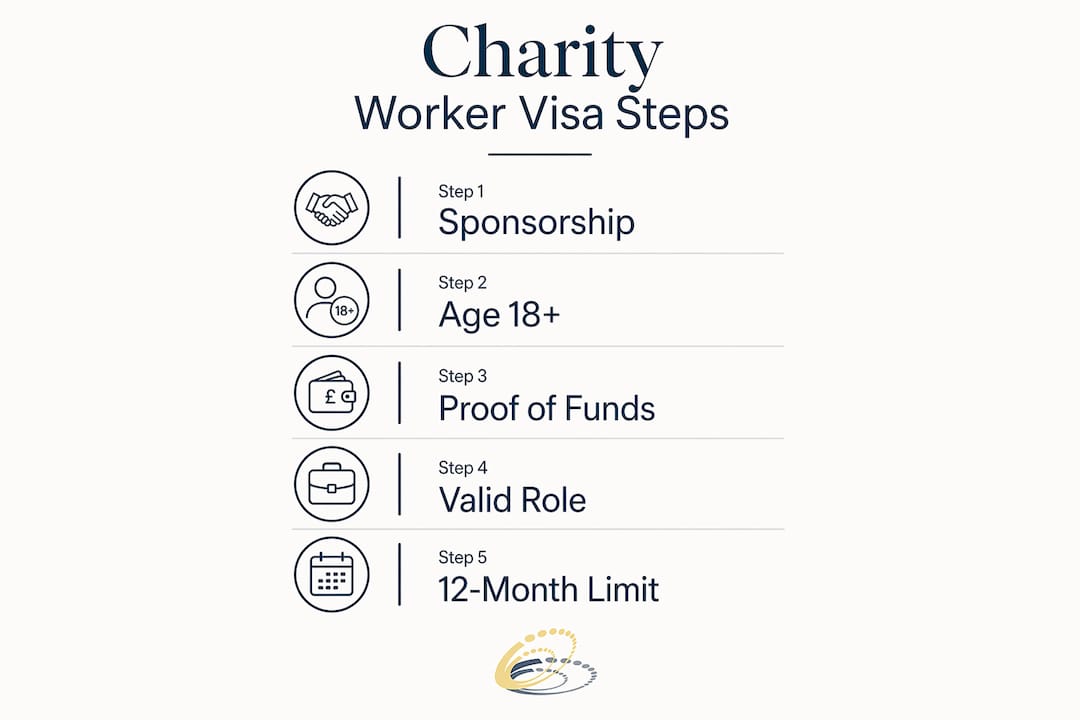
The core rule is straightforward. You must be sponsored by a UK charity that holds an A-rated sponsor licence, and your role must be genuinely unpaid. The visa permits stays of up to 12 months. Extensions are not available, so both volunteers and charities must plan project timelines accordingly.

Two other requirements apply from the outset. You must be at least 18 years old. You must also demonstrate you hold £1,270 in maintenance funds, held for 28 consecutive days before you apply, unless your sponsor certifies your maintenance on the Certificate of Sponsorship.
Who qualifies for the Charity Worker visa?
Eligibility rests on three pillars: your age, your sponsorship, and the nature of your role.
Age and sponsorship requirements
You must be 18 or over. Your sponsoring organisation must hold an A-rated licence from the Home Office. Without that rating, no Certificate of Sponsorship (CoS) can be issued, and your application will fail at the first stage.
What roles count as eligible voluntary work?
The definition of eligible charity work is strict. Your role must be unpaid, contribute directly to the charity’s objectives, and involve genuine fieldwork. The following roles are explicitly excluded:
- Administrative or office support work
- Retail roles, including charity shop work
- Fundraising activities
- Any role that does not directly advance the charity’s charitable mission
This distinction matters more than most applicants realise. A volunteer helping deliver food parcels to vulnerable people qualifies. A volunteer answering phones in a charity’s head office does not. The Home Office assesses whether the role genuinely supports the charity’s purpose, not just whether the organisation is a registered charity.
Payment and expenses
Volunteers cannot receive wages or any payment resembling a salary. The only permitted reimbursement is reasonable expenses, such as travel costs and accommodation directly related to the voluntary work. Any payment beyond that risks the sponsor’s licence and triggers a refusal.
Pro Tip: Ask your sponsoring charity to provide a written expenses policy before you apply. If the Home Office queries your financial arrangements, a clear policy document strengthens your application considerably.
Cooling-off period
Repeat Charity Worker visas require a 12-month absence from the UK after your previous visa expires before you can apply again. This cooling-off period affects long-term project planning and catches returning volunteers by surprise. Plan your timelines before committing to a second placement.
How to apply for a Charity Worker visa
The application process follows a defined sequence. Missing any step is the most common reason for refusals.
- Confirm your sponsor’s licence status. Check that your charity holds an A-rated sponsor licence on the Home Office register. An unlicensed or B-rated sponsor cannot issue a valid CoS.
- Obtain your Certificate of Sponsorship. The CoS is an electronic record, not a paper document. Your sponsor issues it through the Home Office Sponsor Management System. It must include your role details and, where applicable, confirmation that your sponsor is certifying your maintenance.
- Gather your documents. You will need a valid passport or travel document, your CoS reference number, evidence of your maintenance funds (bank statements covering 28 consecutive days showing at least £1,270), and any supporting documents your sponsor provides about the role.
- Apply online. Submit your application through the UK Visas and Immigration online portal. Pay the application fee and the Immigration Health Surcharge where applicable.
- Provide biometric information. Attend a biometric appointment at a Visa Application Centre in your country of residence to provide fingerprints and a photograph.
- Await a decision. Standard processing times vary by country. Priority services are available in some locations for an additional fee.
Pro Tip: Many refusals occur because maintenance funds are not held for the full 28 consecutive days before the application date. Set a calendar reminder so your bank statements cover the correct period before you submit.
Common refusal reasons
The three most frequent causes of refusal are: an invalid or incorrectly completed CoS, insufficient maintenance funds, and a role that does not meet the eligible voluntary work definition. Addressing all three before submission is the most reliable way to avoid a refusal.
Can you volunteer on a Standard Visitor visa?
Short-term volunteering under a Standard Visitor visa is permitted in limited circumstances. Volunteering of up to 30 days for a registered charity is allowed, but only if it is incidental to the main purpose of your visit. Volunteering cannot be the primary reason you enter the UK on a Standard Visitor visa.
The table below sets out the key differences between the two routes.
| Feature | Charity Worker visa | Standard Visitor visa |
|---|---|---|
| Maximum duration | Up to 12 months | Up to 6 months (volunteering max 30 days) |
| Volunteering as main purpose | Yes | No |
| Sponsorship required | Yes, A-rated charity | No |
| Paid work permitted | No | No |
| Leads to settlement | No | No |
| Maintenance funds required | Yes, £1,270 for 28 days | Must show sufficient funds for visit |
For more detail on the Standard Visitor visa rules and how they interact with short-term volunteering, the Mnssolicitors blog provides a dedicated 2026 guide.
The rules for Standard Visitor volunteering are firm on one point. If a Home Office officer concludes that volunteering was your primary reason for entering the UK, you are in breach of your visa conditions. The consequences range from removal to a future entry ban. Do not treat the Standard Visitor route as a workaround for the Charity Worker visa.
- Volunteering must be secondary to tourism, family visits, or another permitted activity
- The charity must be a registered UK charity
- No payment or wage-equivalent benefit is permitted
- The 30-day limit applies to the volunteering activity, not the overall visit
Legal compliance for volunteers and sponsoring charities
Compliance is a shared responsibility. Both the volunteer and the sponsoring charity carry obligations under the Immigration Rules.
Sponsor responsibilities
The charity must maintain its A-rated sponsor licence throughout the period of your visa. If the charity’s licence is downgraded or revoked, your visa may be curtailed. Charities must also report any changes to your role or circumstances to the Home Office through the Sponsor Management System.
The 12-month rule and visa expiry
The visa duration is up to 12 months with no extension available. Volunteers must leave the UK at or before their visa expiry date. Overstaying, even by a single day, creates a negative immigration history that affects future visa applications. Charities must plan project timelines to fit within this cap.
Pro Tip: Book your return travel before your visa expires, not after. The Home Office treats overstaying as a serious breach, and even short overstays are recorded on your immigration history.
Prohibited activities
The following are not permitted under the Charity Worker visa:
- Taking paid employment of any kind
- Undertaking voluntary work for an organisation that is not your sponsor
- Switching into the Charity Worker visa from within the UK (in most circumstances)
- Extending the visa beyond 12 months
Certain other visa holders, such as those on a Skilled Worker visa, may undertake voluntary work related to their sponsored employment. However, the Charity Worker visa is the required route for anyone whose primary purpose in the UK is unpaid charity work.
Consequences of non-compliance
Non-compliance carries real consequences. For volunteers, breaching visa conditions can result in removal, a re-entry ban, and a refusal on any future UK visa application. For charities, sponsoring a volunteer who breaches their conditions risks a downgrade or revocation of the sponsor licence, which affects every sponsored worker the charity employs.
Key takeaways
The Charity Worker visa is the only UK immigration route for unpaid voluntary work lasting more than 30 days, and it requires A-rated sponsorship, maintenance funds of £1,270, and a role directly aligned with the charity’s objectives.
| Point | Details |
|---|---|
| Official visa route | The Charity Worker visa is the correct route for unpaid voluntary work in the UK. |
| Sponsorship is mandatory | Your sponsor must hold an A-rated Home Office licence before issuing a Certificate of Sponsorship. |
| Eligible roles are specific | Only fieldwork directly supporting the charity’s mission qualifies; admin and retail roles do not. |
| Short-term alternative | Standard Visitor visa permits up to 30 days of volunteering, but only as a secondary activity. |
| 12-month cooling-off period | After a Charity Worker visa expires, you must spend 12 months outside the UK before applying again. |
My view on where volunteers go wrong
The single biggest misunderstanding I encounter is the assumption that any unpaid work for a charity automatically qualifies for a Charity Worker visa. It does not. The Home Office is specific: the role must directly advance the charity’s charitable objectives. I have seen applications refused because the volunteer was assigned to a charity’s administrative team rather than its frontline programme. The distinction feels minor to the applicant but is decisive to a caseworker.
The second issue is maintenance funds. Applicants often check their bank balance the day before they apply. The rules require £1,270 held for 28 consecutive days. A single dip below that figure during the period invalidates the evidence. I would always advise setting the funds aside in a separate account and leaving them untouched for the full period before applying.
The cooling-off period is the third area where planning breaks down. Charities sometimes invite the same volunteer back for a second placement without checking whether 12 months have passed since the previous visa expired. That oversight results in a refusal that could have been avoided with a calendar check.
My strongest advice is this: if you are uncertain whether your role qualifies, or if your sponsor’s licence status is unclear, take qualified legal advice before you apply. A refusal is far more disruptive than a short delay to get the application right.
— michelle
Voluntary work visa support from Mnssolicitors
Charity Worker visa applications involve precise legal requirements, and a single error can result in refusal or a sponsor losing their licence.

Mnssolicitors specialises in UK visa and immigration law, with every enquiry handled by a qualified solicitor from the outset. The firm offers fixed, transparent pricing with no hidden fees, and a fast-track service that can prepare applications in as little as 24 hours. Whether you need guidance on eligibility, help preparing your documentation, or support with a visa appeal after a refusal, Mnssolicitors provides clear, reliable advice. Contact the team directly for personalised support on your UK immigration application.
FAQ
What is the Charity Worker visa?
The Charity Worker visa is the official UK route for unpaid voluntary work at a licensed UK charity, permitting stays of up to 12 months with A-rated sponsorship.
Does a volunteer always need a visa to work in the UK?
Not always. Volunteering for up to 30 days as a secondary activity is permitted on a Standard Visitor visa, but longer or primary voluntary roles require a Charity Worker visa.
What maintenance funds are required for a Charity Worker visa?
Applicants must hold £1,270 for 28 consecutive days before applying, unless the sponsoring charity certifies maintenance on the Certificate of Sponsorship.
Can a Charity Worker visa be extended?
No. The visa lasts up to 12 months and cannot be extended. Volunteers must leave the UK by their visa expiry date and wait 12 months before applying again.
What happens if a volunteer breaches their visa conditions?
Breaching visa conditions can result in removal from the UK, a re-entry ban, and refusals on future visa applications. Sponsoring charities also risk losing their sponsor licence.
Leave a Reply