
A UK visa crisis submission is defined as any urgent application where time pressure, a prior mistake, or an unexpected change in circumstances forces you to act quickly and accurately. UK Visas and Immigration (UKVI) processes thousands of applications weekly, and errors under pressure are the leading cause of avoidable refusals. Immigration Rules Part 9 governs suitability grounds, meaning undisclosed facts or inconsistencies can result not just in refusal but in re-entry bans. The Immigration Health Surcharge (IHS) adds significant cost to every application. Getting your submission right the first time is the only reliable strategy.
What do you need before starting an urgent UK visa application?
Preparation is the single biggest factor separating successful urgent applications from failed ones. Before you open the GOV.UK application portal, you must confirm the correct visa route using the official GOV.UK visa checker. Applying on the wrong route wastes fees and time you cannot afford in a crisis.
Documents you must gather first
The core documents required for most UK visa routes are consistent, though route-specific additions apply:
- Valid passport with at least six months’ validity beyond your intended stay
- Sponsorship certificate or letter (for work, student, or family routes)
- Financial evidence covering bank statements for the past three to six months
- English language proof such as a Secure English Language Test (SELT) certificate or degree transcript
- Biometric Residence Permit (if you hold one from a previous UK stay)
- Photographs meeting UKVI specifications
Non-English documents require certified translations with a formal statement confirming truthfulness, the date, and the translator’s contact details. DIY or family translations are rejected outright. A single certified page typically costs £40–£100, so budget for this early.
Understanding costs before you apply

The IHS costs £1,035 per year for most visa routes in 2026. That figure applies per applicant and per year of leave granted, meaning a five-year visa generates a substantial surcharge before you even pay the application fee itself. Factor this into your financial planning before submission.
| Cost item | Typical amount (2026) |
|---|---|
| Immigration Health Surcharge | £1,035 per year of leave |
| Certified translation (per page) | £40–£100 |
| Priority processing (overseas) | Additional fee on top of visa fee |
| Super-priority processing (overseas) | Higher additional fee |
| On-site document scanning | Per-document fee at biometric centre |
Pro Tip: Verify your eligibility criteria on GOV.UK before gathering any documents. Applying on an incorrect route means losing your application fee entirely, with no refund.
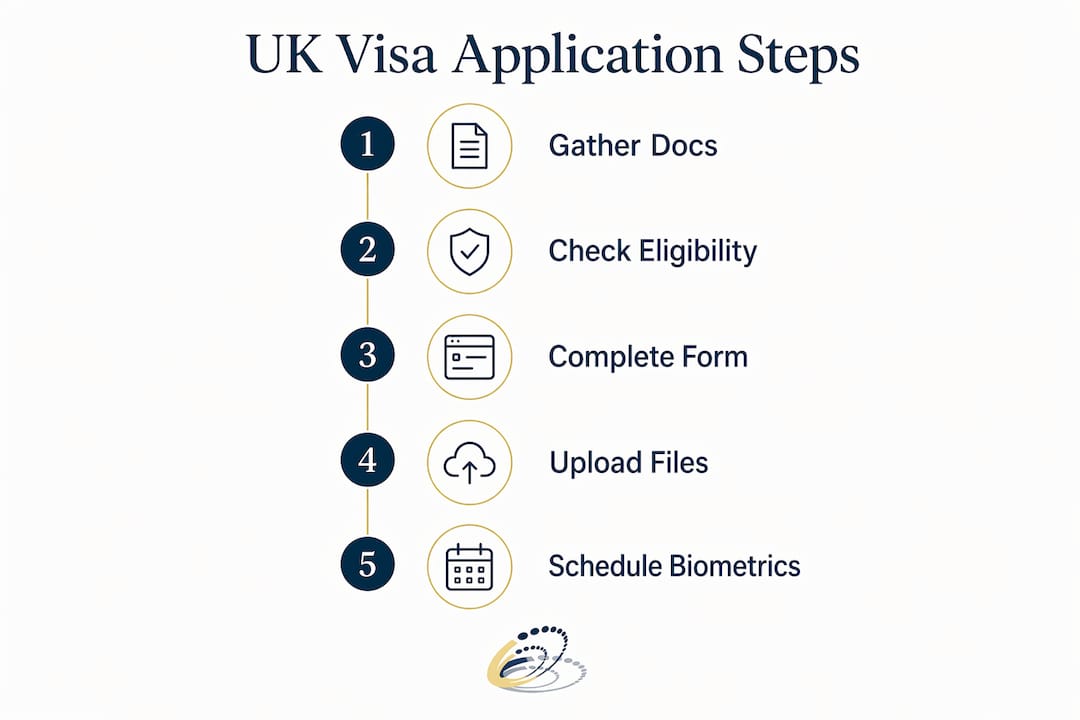
How do you submit an urgent UK visa application step by step?
The UK visa application process follows a fixed sequence. Deviating from it, even slightly, causes delays that are impossible to recover quickly.
-
Start your online application on GOV.UK. Select your specific visa route. Each route generates a tailored form, so route accuracy matters from the outset.
-
Complete the application form carefully. Every field must be internally consistent. Your name must match your passport exactly, character for character. Misaligned name spelling across your passport, form, and supporting documents is a consistent cause of avoidable refusals.
-
Pay the visa fee and IHS. Both payments are made online during the application. You cannot proceed to document upload or biometric booking without completing payment.
-
Create or log into your UKVI customer account. This account is where you self-upload supporting documents. Uploading via the UKVI portal is free. On-site scanning at a biometric centre carries per-document fees and causes delays.
-
Upload all documents before the deadline. The UKVI upload window closes 24–48 hours before your biometric appointment. Missing this window forces paid on-site scanning, which adds cost and stress to an already urgent situation.
-
Book and attend your biometric appointment. For eligible routes, the UK Immigration: ID Check app allows identity verification without visiting a biometric centre. This option can accelerate the process significantly when you are under time pressure.
-
Monitor your application status. Log into your UKVI account regularly. Respond to any requests for additional information immediately.
Processing timelines you should expect
| Processing type | Typical timeline (overseas, 2026) |
|---|---|
| Standard | 3–8 weeks |
| Priority | 2–3 weeks |
| Super-priority | 1–2 weeks |
Standard overseas processing takes 3–8 weeks. If your situation demands faster resolution, priority and super-priority services exist but carry additional fees. For same-day options, see the fast-track visa guide from Mnssolicitors.
Pro Tip: Complete your document upload five to seven days before your biometric appointment. This gives you time to resolve any upload errors, such as file size rejections, without missing the 24–48 hour deadline.
What are the most common mistakes in urgent UK visa submissions?
Speed creates errors. Under crisis conditions, applicants routinely make the same avoidable mistakes that result in refusal or costly delays.
-
Submitting before all documents are ready. The application form locks immediately after submission and cannot be edited. Submitting with missing documents is not recoverable without withdrawal.
-
Uploading unsupported file formats. UKVI accepts specific file types and size limits. PDFs are standard. Large files can be split into multiple PDFs or compressed to resolve upload rejections without losing legibility.
-
Missing the upload window. Failing to upload before the 24–48 hour pre-appointment deadline results in paid on-site scanning. Plan your upload well in advance.
-
Inconsistent travel history or character disclosures. UKVI decision-makers distinguish between innocent mistakes and deception. Failure to disclose material facts risks refusal under Part 9 of the Immigration Rules, and in serious cases, a re-entry ban.
-
Financial evidence gaps. Most refusals stem from incomplete finances, salary mismatches, incorrect occupation codes, and undisclosed immigration history. Every figure in your financial evidence must align with your employer records and tax documents.
-
Using unofficial translations. Certified translations must include formal attestation. A translation produced by a family member or unaccredited service will be rejected.
Full and accurate disclosure on your character, immigration history, and personal circumstances is not optional. Omitting facts that UKVI would consider material is treated as deception under Part 9 of the Immigration Rules, regardless of your intent. The consequences include refusal and potential re-entry bans lasting years. When in doubt, disclose and explain.
Pro Tip: Before submitting, read every section of your completed form aloud against your supporting documents. Inconsistencies that look minor on screen become grounds for refusal in the hands of a decision-maker.
What should you do if you made a mistake or face delays?
Discovering an error after submission is alarming, but your response determines the outcome. Act quickly and assess the nature of the mistake before deciding on a course of action.
-
Classify the error. An innocent mistake, such as a minor typo in an address, carries different risk from a material omission, such as an undisclosed previous visa refusal. The distinction matters under Part 9 of the Immigration Rules.
-
Contact UKVI immediately for minor errors. UKVI has limited capacity to amend submitted applications, but contacting them promptly for genuinely minor corrections is always worth attempting. Do not delay.
-
Consider withdrawal for significant errors. No formal amendment process exists after submission. For material mistakes, withdrawing and reapplying with a corrected, complete application is often the safer option. Withdrawal forfeits your application fee, but it avoids a refusal on your record.
-
Seek specialist legal advice for suitability issues. When the error involves character disclosures, immigration history, or anything that touches Part 9 suitability grounds, legal advice is critical. Explaining a suitability issue poorly can worsen the outcome. A qualified solicitor can frame the explanation correctly.
-
Use fast-track services if delays threaten your travel. Super-priority processing delivers a decision in 1–2 weeks for overseas applicants. For guidance on managing emergency situations, the emergency fast-track guide from Mnssolicitors covers the process in detail.
Pro Tip: If you are unsure whether your error is innocent or material, treat it as material until a qualified solicitor confirms otherwise. The cost of professional advice is far lower than the cost of a refusal and re-entry ban.
Key takeaways
Successful urgent UK visa submissions depend on accurate documents, early preparation, and full disclosure before the application form locks.
| Point | Details |
|---|---|
| Prepare documents before starting | Gather all evidence, certified translations, and financial proof before opening the GOV.UK form. |
| Upload early, not at the last minute | The UKVI portal closes 24–48 hours before biometrics; missing it means costly on-site scanning. |
| Disclose everything material | Omitting immigration history or character facts risks refusal and re-entry bans under Part 9. |
| Withdrawal beats a bad refusal | No amendment process exists post-submission; withdrawing and reapplying protects your record. |
| Use priority services when time is critical | Super-priority processing delivers decisions in 1–2 weeks for overseas applicants in 2026. |
What I have learned from urgent UK visa submissions
The most consistent pattern I see in crisis applications is not complexity. It is avoidable haste. Applicants under pressure submit forms before their documents are ready, then discover the form is locked and their options are limited to withdrawal or refusal. The 2026 digital upload system is genuinely helpful, but only if you use it correctly and early.
The ID Check app is one of the most underused tools available right now. For eligible routes, it removes the biometric centre visit entirely, which can save days in an urgent situation. Most applicants do not realise this option exists until they are already booked into a centre two weeks away.
The disclosure question is where I see the most serious errors. Applicants assume that a previous visa refusal from years ago is irrelevant, or that a minor criminal matter does not need mentioning. UKVI’s suitability assessment under Part 9 is thorough. Early and transparent disclosure on character and immigration history reduces credibility refusals more reliably than any other single action.
My honest advice: slow down by one day. Use that day to cross-check every document against the form, verify your urgent visa documents checklist, and confirm your upload is complete. That one day of preparation is worth more than any fast-track service.
— michelle
How Mnssolicitors supports urgent UK visa applications
Facing a visa crisis without specialist support significantly increases your risk of refusal. Mnssolicitors handles visitor, student, spouse, and urgent visa applications, with every case managed by a qualified solicitor from the first contact. There are no trainees handling your file, and pricing is fixed with no hidden fees.

Mnssolicitors offers a same-day urgent visa service capable of preparing applications in as little as 24 hours. The firm holds over 170 five-star Google reviews, reflecting consistent results for clients in exactly the kind of time-pressured situations this guide addresses. Whether you need support with a visitor visa application or a complex spouse visa under urgent conditions, Mnssolicitors provides the expertise and speed that crisis situations demand.
FAQ
What is a UK visa crisis submission?
A UK visa crisis submission is an urgent application made under time pressure, following a mistake, or after an unexpected change in circumstances that requires immediate and accurate action to avoid refusal.
Can I change my UK visa application after submitting it?
No. The application form locks immediately after submission and cannot be edited. For significant errors, withdrawing and reapplying is the recommended course of action.
How long does urgent UK visa processing take in 2026?
Super-priority processing takes 1–2 weeks for overseas applicants. Priority processing takes 2–3 weeks. Standard processing takes 3–8 weeks.
What happens if I miss the document upload deadline?
Missing the UKVI upload window, which closes 24–48 hours before your biometric appointment, means your documents must be scanned on-site at the biometric centre, which carries per-document fees and potential delays.
When should I get legal advice for a UK visa application?
Seek legal advice immediately if your application involves a previous refusal, undisclosed immigration history, a character issue, or any error that touches suitability grounds under Part 9 of the Immigration Rules.
Leave a Reply