
An emergency UK visa, formally processed through UK Visas and Immigration’s Priority or Super Priority service, is the fastest legal route to securing a decision when time is critical. The standard overseas processing time runs approximately 3 weeks. Priority Service cuts that to 5 working days; Super Priority aims for a next working day decision. Knowing the exact emergency UK visa steps before you begin saves you from costly errors that cannot be corrected after submission. This guide covers every stage, from document preparation to biometric appointments, and flags the pitfalls that derail even well-prepared applicants.
What documents and requirements do you need for an urgent visa application UK?
Every successful urgent visa application UK starts with the same foundation: a complete GOV.UK online application form, the correct supporting documents, and full payment of all fees before your biometric appointment. Missing any one of these three elements stops your application before it reaches a caseworker.
The supporting documents you need depend on your visa route, but the core set applies across most categories:
- Valid passport with at least one blank page
- Recent passport-sized photographs meeting UKVI specifications
- Proof of financial means (bank statements, payslips, or sponsor letters)
- Evidence of your purpose of travel (invitation letters, employment contracts, or university offer letters)
- Completed Immigration Health Surcharge (IHS) payment confirmation
- Priority or Super Priority service fee payment receipt
Fees stack up quickly. The visa application fee varies by route, the IHS is charged per year of leave, and the Priority Service costs £500 on top of everything else. Super Priority adds £1,000. Budget for all three before you start.
Pro Tip: Check priority service availability on the GOV.UK application page before paying anything. Eligibility varies by visa type and location, and the option only appears if it is available for your specific route and UKVCAS centre.
Biometric enrolment is mandatory for most applicants. You can either attend a UK Visa and Citizenship Application Services (UKVCAS) centre or, if eligible, use the UK Visas and Immigration ID Check app to submit your biometrics digitally. The app route is faster, but eligibility is limited. Confirm your route before booking.
| Requirement | Details |
|---|---|
| GOV.UK application form | Completed online; treated as a legal submission |
| Supporting documents | Passport, financials, purpose of travel evidence |
| IHS payment | Required for most leave to remain applications |
| Visa and priority fees | Paid at application stage; non-refundable in most cases |
| Biometric enrolment | UKVCAS appointment or ID Check app where eligible |
How do you apply step-by-step for expedited UK visa steps?
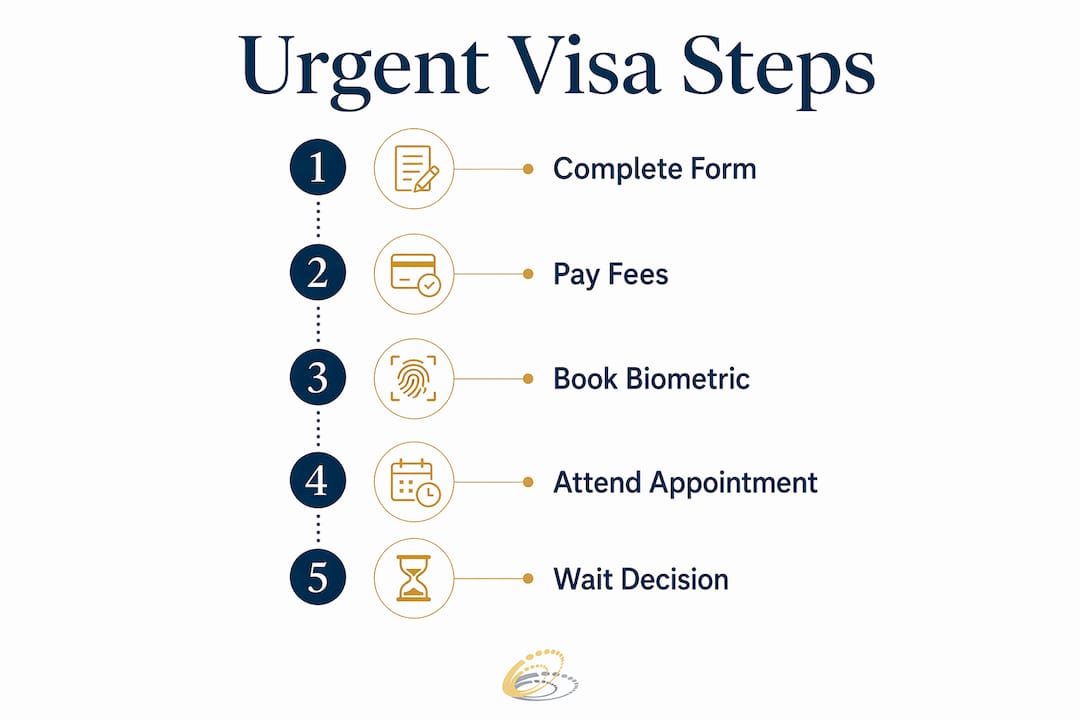
The GOV.UK portal is the only official starting point for any UK visa application. Third-party websites that charge a fee to “help you apply” are not part of the official process and add unnecessary cost and risk.
Follow these steps in order:
- Select your visa route on GOV.UK. Choosing the wrong category is one of the most common and damaging errors. If you are unsure, seek legal advice before proceeding.
- Complete the application form with full accuracy. UKVI treats the form as a legal submission, so errors or omissions can trigger refusal or deeper scrutiny.
- Pay all fees at the payment stage. This is the point where you select Priority or Super Priority service. The option appears on screen only if it is available for your route and location.
- Book your biometric appointment at a UKVCAS centre as soon as payment is confirmed. Appointment slots fill quickly, particularly in major cities. Delay here undermines the entire priority timeline.
- Upload all supporting documents before your biometric appointment deadline. Documents submitted after the deadline are not guaranteed to be considered.
- Attend your biometric appointment or complete the ID Check app process. Bring your appointment confirmation and original documents.
- Monitor your application through the UKVI online tracking system. Decisions are communicated by email and through the portal.
Pro Tip: Priority cannot be added after you submit your application. If you forget to select it at the payment stage, you must withdraw your application and reapply, which means losing your original fees and restarting the clock.
The processing clock starts from the date UKVI receives your biometric enrolment, not from the date you submit the form online. Book your biometric appointment for the earliest available slot. Every day of delay at that stage is a day lost from your priority window.

What common issues cause delays in urgent UK visa applications?
The single most misunderstood fact about priority processing is this: priority service speeds the decision, not the outcome. Paying £500 or £1,000 does not increase your chances of approval. It only moves your application to the front of the queue.
Minor errors in your application trigger deeper scrutiny that voids priority processing time targets. A caseworker who identifies an inconsistency must investigate further, and that investigation is not bound by the priority timeline. The result is a delayed decision with no refund on the priority fee.
The most common causes of delay are:
- Incomplete or inconsistent financial evidence
- Missing translations for documents not in English or Welsh
- Photographs that do not meet UKVI specifications
- Discrepancies between the application form and supporting documents
- Outstanding security checks or medical reviews
Critical: Travelling outside the Common Travel Area while a leave to remain application is pending results in the application being treated as withdrawn under paragraph 34K of the Immigration Rules. You lose your application, your fees, and your leave status. Do not travel internationally until you have a decision in hand.
Security, document verification, or medical reviews can pause priority timelines entirely, with no automatic refund of the priority fee. If your application involves any of these factors, factor in additional time and seek specialist advice before selecting a priority tier.
If the priority deadline passes without a decision, you have three options: wait, contact UKVI directly through the official enquiry service, or submit a formal complaint. Contacting UKVI before the stated processing time has elapsed rarely produces results and can create confusion in your case record.
Pro Tip: Treat your application as if priority service does not exist. Build the strongest possible evidenced case first. Then add priority service as a timing tool, not a substitute for preparation.
How do Priority and Super Priority services compare?
The two fast-track tiers serve different levels of urgency and carry different costs, availability restrictions, and risk profiles.
| Feature | Priority Service | Super Priority Service |
|---|---|---|
| Fee | £500 | £1,000 |
| Target decision time | 5 working days | Next working day |
| Availability | Most visa routes, overseas and in-country | Primarily in-country UKVCAS applications |
| Refund if missed | No automatic refund | No automatic refund |
| Suitable for | Planned urgent travel | Genuine same-day or next-day need |
Super Priority Service availability is often limited to in-country applications through UKVCAS centres. It does not appear as an option on the application page if it is unavailable for your route or location. Applicants who assume it will be available and plan around it risk serious disruption when it does not appear at the payment stage.
Priority Service is the more accessible option and suits most urgent situations where the need is within a week. Super Priority is appropriate only when the decision is genuinely needed the next working day and the applicant is applying from within the UK through a UKVCAS centre.
Neither service guarantees a refund if the target time is missed due to additional checks. The fees are paid for access to the fast-track queue, not for a guaranteed outcome within the stated timeframe. Applicants with complex cases involving prior refusals, criminal records, or medical conditions should weigh this carefully before paying the premium.
Key takeaways
Selecting the correct priority tier and submitting a fully evidenced application are the two factors that determine whether urgent UK visa processing delivers a timely decision.
| Point | Details |
|---|---|
| Priority speeds decisions, not approvals | Paying for Priority or Super Priority moves your place in the queue, not your likelihood of success. |
| Select priority at payment stage only | You cannot add priority after submission; reapplying means losing original fees and restarting processing. |
| Biometric booking drives the timeline | Processing starts from biometric enrolment, so book the earliest available appointment immediately. |
| Travelling during a pending application is high risk | Leaving the Common Travel Area while a leave to remain application is pending triggers automatic withdrawal. |
| Complex cases need specialist support | Security checks, prior refusals, or medical reviews can void priority timelines without any fee refund. |
What I have learned from watching urgent applications succeed and fail
Working alongside applicants in urgent situations, the pattern is consistent. The applications that succeed quickly are not the ones with the highest priority tier. They are the ones where every document is in order, every figure matches, and every question on the form has been answered with precision.
The applicants who struggle are often those who treat the priority fee as the solution rather than the submission. They rush the form, upload incomplete bank statements, or forget translated documents. The caseworker then pauses the priority clock, and the applicant is left waiting with no recourse and no refund.
The travel risk is the one that causes the most distress. Applicants with leave to remain applications pending sometimes travel for family emergencies, not realising that paragraph 34K of the Immigration Rules treats departure from the Common Travel Area as automatic withdrawal. By the time they return, their application no longer exists. Rebuilding from that position is far more expensive and time-consuming than the original application.
My consistent advice: consult a regulated immigration specialist before you select your visa route, before you pay any fees, and certainly before you travel. The cost of an hour’s legal advice is a fraction of the cost of a withdrawn application or a refused priority fee. Preparation is the only reliable fast-track.
— michelle
Urgent UK visa help from Mnssolicitors
Facing an urgent visa deadline is stressful. Getting the application wrong under time pressure makes it significantly worse.

Mnssolicitors specialises in urgent visa applications and can prepare a full case in as little as 24 hours. Every enquiry is handled by a qualified solicitor from the first contact, with fixed, transparent fees and no hidden costs. With over 170 five-star Google reviews, Mnssolicitors has a proven record of guiding clients through complex and time-sensitive immigration matters. Whether you need a visitor visa, a leave to remain extension, or a spouse visa processed urgently, the team is ready to assess your case the same day.
FAQ
What is the fastest way to get a UK visa decision?
Super Priority Service targets a next working day decision and is the fastest option available through UKVI. It is primarily available for in-country applications through UKVCAS centres and costs £1,000.
Can I add priority service after submitting my UK visa application?
No. Priority service must be selected at the payment stage during the original application. Adding it afterwards requires withdrawing the application and reapplying, which means losing the original fees.
Does priority service guarantee my UK visa will be approved?
Priority service does not influence the outcome of your application. It is a fast-track to a decision, not a fast-track to approval. The strength of your evidence determines the result.
What happens if I travel while my UK visa application is pending?
Travelling outside the Common Travel Area while a leave to remain application is pending causes the application to be treated as withdrawn under paragraph 34K of the Immigration Rules. You lose the application and the fees paid.
How long does a standard UK visa application take without priority?
Standard overseas processing takes approximately 3 weeks. Priority Service reduces this to 5 working days, and Super Priority targets a next working day decision, though complex cases may take longer regardless of the tier selected.
Leave a Reply